CHAPTER 50
OFFICE OF POLICY AND MANAGEMENT:
GENERAL PROVISIONS; BUDGET AND APPROPRIATIONS;
STATE PLANNING
Table of Contents
Note: This 2026 Supplement is intended to be used in conjunction with the General Statutes of Connecticut, revised to January 1, 2025.
Sec. 4-66c. Urban action bonds.
Sec. 4-66h. Main Street Investment Fund account. Distribution of funds.
Sec. 4-66k. Regional planning incentive account.
Sec. 4-66l. Municipal revenue sharing account. Grants.
Sec. 4-66n. Municipal reimbursement and revenue account. Distribution of funds.
Sec. 4-66o. Receivables for anticipated revenue.
Sec. 4-66p. Municipal Revenue Sharing Fund. Grants.
Sec. 4-66aa. Donald E. Williams, Jr. community investment account. Distribution of funds.
Sec. 4-66cc. Agricultural sustainability account.
Sec. 4-67z. Review of legal obstacles to sharing of high value data.
Sec. 4-68aa. Social innovation investment enterprise. Social innovation account.
Sec. 4-68cc. Neighborhood Security Fellowship Program.
Sec. 4-68ii. Municipal fair share allocations.
Sec. 4-68aaa. Youth sports grant program for distressed municipalities.
Sec. 4-68ccc. Loans for water quality project.
Sec. 4-73. Recommended appropriations.
Sec. 4-77c. Estimates of expenditure requirements for implementation of evidence-based programs.
Sec. 4-85d. Submission of accounting of federal energy funds.
Sec. 4-95b. Transfer of funds to implement improvements to fiscal and related reporting procedures.
Sec. 4-124s. Regional performance incentive program.
Sec. 4-124w. Office of Workforce Strategy. Responsibilities.
Sec. 4-124jj. Office of Workforce Strategy account. Report.
Sec. 4-124yy. Paramedic certificate program financial aid and evaluation.
PART I
GENERAL PROVISIONS
Sec. 4-66c. Urban action bonds. (a) For the purposes of subsection (b) of this section, the State Bond Commission shall have power, from time to time to authorize the issuance of bonds of the state in one or more series and in principal amounts not exceeding in the aggregate three billion forty-four million four hundred eighty-seven thousand five hundred forty-four dollars, provided two hundred million dollars of said authorization shall be effective July 1, 2026. All provisions of section 3-20, or the exercise of any right or power granted thereby, which are not inconsistent with the provisions of this section, are hereby adopted and shall apply to all bonds authorized by the State Bond Commission pursuant to this section, and temporary notes in anticipation of the money to be derived from the sale of any such bonds so authorized may be issued in accordance with said section 3-20 and from time to time renewed. Such bonds shall mature at such time or times not exceeding twenty years from their respective dates as may be provided in or pursuant to the resolution or resolutions of the State Bond Commission authorizing such bonds. None of said bonds shall be authorized except upon a finding by the State Bond Commission that there has been filed with it a request for such authorization, which is signed by or on behalf of the Secretary of the Office of Policy and Management and states such terms and conditions as said commission in its discretion may require. Said bonds issued pursuant to this section shall be general obligations of the state and the full faith and credit of the state of Connecticut are pledged for the payment of the principal of and interest on said bonds as the same become due, and accordingly as part of the contract of the state with the holders of said bonds, appropriation of all amounts necessary for punctual payment of such principal and interest is hereby made, and the Treasurer shall pay such principal and interest as the same become due.
(b) (1) The proceeds of the sale of said bonds, to the extent hereinafter stated, shall be used, subject to the provisions of subsections (c) and (d) of this section, for the purpose of redirecting, improving and expanding state activities which promote community conservation and development and improve the quality of life for urban residents of the state as hereinafter stated: (A) For the Department of Economic and Community Development: Economic and community development projects, including administrative costs incurred by the Department of Economic and Community Development, not exceeding sixty-seven million eight hundred forty-one thousand six hundred forty-two dollars, one million dollars of which shall be used for a grant to the development center program and the nonprofit business consortium deployment center approved pursuant to section 32-411; (B) for the Department of Transportation: Urban mass transit, not exceeding two million dollars; (C) for the Department of Energy and Environmental Protection: Recreation development and solid waste disposal projects, not exceeding one million nine hundred ninety-five thousand nine hundred two dollars; (D) for the Department of Social Services: Child day care projects, elderly centers, shelter facilities for victims of domestic violence, emergency shelters and related facilities for the homeless, multipurpose human resource centers and food distribution facilities, not exceeding thirty-nine million one hundred thousand dollars, provided four million dollars of said authorization shall be effective July 1, 1994; (E) for the Department of Economic and Community Development: Housing projects, not exceeding three million dollars; (F) for the Department of Housing: Homeownership initiative in collaboration with one or more local community development financial institutions in qualified census tracts for the purpose of construction or redevelopment, performed by developers or nonprofit organizations residing in that municipality, which leads to new homeownership opportunities for residents of such qualified census tracts, not exceeding twenty million dollars; (G) for the Office of Policy and Management: (i) Grants-in-aid to municipalities for a pilot demonstration program to leverage private contributions for redevelopment of designated historic preservation areas, not exceeding one million dollars; (ii) grants-in-aid for urban development projects including economic and community development, transportation, environmental protection, public safety, children and families and social services projects and programs, including, in the case of economic and community development projects administered on behalf of the Office of Policy and Management by the Department of Economic and Community Development, administrative costs incurred by the Department of Economic and Community Development, not exceeding two billion nine hundred nine million five hundred fifty thousand dollars, provided two hundred million dollars of said authorization shall be effective July 1, 2026. For purposes of this subdivision, “local community development financial institution” means an entity that meets the requirements of 12 CFR 1805.201, and “qualified census tract” means a census tract designated as a qualified census tract by the Secretary of Housing and Urban Development in accordance with 26 USC 42(d)(5)(B)(ii), as amended from time to time.
(2) (A) Five million dollars of the grants-in-aid authorized in subparagraph (G)(ii) of subdivision (1) of this subsection may be made available to private nonprofit organizations for the purposes described in said subparagraph (G)(ii). (B) Twelve million dollars of the grants-in-aid authorized in subparagraph (G)(ii) of subdivision (1) of this subsection may be made available for necessary renovations and improvements of libraries. (C) Five million dollars of the grants-in-aid authorized in subparagraph (G)(ii) of subdivision (1) of this subsection shall be made available for small business gap financing. (D) Ten million dollars of the grants-in-aid authorized in subparagraph (G)(ii) of subdivision (1) of this subsection may be made available for regional economic development revolving loan funds. (E) One million four hundred thousand dollars of the grants-in-aid authorized in subparagraph (G)(ii) of subdivision (1) of this subsection shall be made available for rehabilitation and renovation of the Black Rock Library in Bridgeport. (F) Two million five hundred thousand dollars of the grants-in-aid authorized in subparagraph (G)(ii) of subdivision (1) of this subsection shall be made available for site acquisition, renovation and rehabilitation for the Institute for the Hispanic Family in Hartford. (G) Three million dollars of the grants-in-aid authorized in subparagraph (G)(ii) of subdivision (1) of this subsection shall be made available for the acquisition of land and the development of commercial or retail property in New Haven. (H) Seven hundred fifty thousand dollars of the grants-in-aid authorized in subparagraph (G)(ii) of subdivision (1) of this subsection shall be made available for repairs and replacement of the fishing pier at Cummings Park in Stamford. (I) Ten million dollars of the grants-in-aid authorized in subparagraph (G)(ii) of subdivision (1) of this subsection shall be made available for development of an intermodal transportation facility in northeastern Connecticut.
(c) Any proceeds from the sale of bonds authorized pursuant to subsections (a) and (b) of this section or of temporary notes issued in anticipation of the moneys to be derived from the sale of such bonds may be used to fund grants-in-aid to municipalities or the grant-in-aid programs of said departments, including, but not limited to, financial assistance and expenses authorized under chapters 128, 129, 130, 133, 136 and 298, and section 16a-40a, provided any such program shall be implemented in an eligible municipality or is for projects in other municipalities which the State Bond Commission determines will help to meet the goals set forth in section 4-66b. For the purposes of this section, “eligible municipality” means a municipality which is economically distressed within the meaning of subsection (b) of section 32-9p, which is classified as an urban center in any plan adopted by the General Assembly pursuant to section 16a-30, which is classified as a public investment community within the meaning of subdivision (9) of subsection (a) of section 7-545, or in which the State Bond Commission determines that the project in question will help meet the goals set forth in section 4-66b. Notwithstanding the provisions of this subsection, proceeds from the sale of bonds pursuant to this section may, with the approval of the State Bond Commission, be used for transit-oriented development projects, as defined in section 13b-79o, in any municipality.
(d) Any economic development project eligible for assistance under this section may include but not be limited to: (1) The construction or rehabilitation of commercial, industrial and mixed use structures; and (2) the construction, reconstruction or repair of roads, accessways and other site improvements. The state, acting by and in the discretion of the Commissioner of Economic and Community Development, may enter into a contract for state financial assistance for any eligible economic or community development project in the form of a grant-in-aid. Any grant-in-aid shall be in an amount not in excess of the cost of the project for which the grant is made as determined and approved by the Commissioner of Economic and Community Development. Before entering into a grant-in-aid contract the Commissioner of Economic and Community Development shall have approved an application submitted on forms provided by the commissioner and with such information the commissioner deems necessary to evaluate such application. The commissioner shall establish the terms and conditions of any grant-in-aid contract for any economic development project under this section and may make any stipulation in connection with such contract.
(e) Notwithstanding any provision of the general statutes to the contrary, whenever the Department of Economic and Community Development or the Office of Policy and Management is authorized by the general statutes to assess, collect or fund administrative expenses or service charges or otherwise recover costs or expenses incurred by the state in carrying out the provisions of any economic or community development project or program administered by the Department of Economic and Community Development, except in the case of administrative oversight charges described in section 8-37tt amounts so assessed, collected or funded by the state may be used to pay any administrative expenses of the Department of Economic and Community Development and shall not be required to be used to pay expenses related to a particular project or program.
(P.A. 79-607, S. 21; P.A. 80-21, S. 1, 5; 80-411, S. 2, 3; 80-483, S. 11, 186; P.A. 81-472, S. 1, 159; P.A. 83-365; June Sp. Sess. P.A. 83-33, S. 2, 17; P.A. 84-443, S. 1, 20; P.A. 85-558, S. 2, 17; 85-613, S. 16, 154; P.A. 86-396, S. 3, 25; P.A. 87-405, S. 1, 26; P.A. 88-343, S. 3, 32; P.A. 89-211, S. 3; 89-331, S. 4, 30; P.A. 90-297, S. 1, 24; June Sp. Sess. P.A. 91-4, S. 6, 25; May Sp. Sess. P.A. 92-7, S. 1, 36; P.A. 93-262, S. 1, 87; 93-382, S. 53, 69; June Sp. Sess. P.A. 93-1, S. 1, 45; P.A. 95-250, S. 1; 95-272, S. 1, 29; P.A. 96-181, S. 104, 121; 96-211, S. 1, 5, 6; 96-256, S. 169, 209; June 5 Sp. Sess. P.A. 97-1, S. 2, 20; P.A. 98-259, S. 1, 17; P.A. 99-241, S. 2, 66; 99-242, S. 88, 90; P.A. 00-167, S. 57, 69; June Sp. Sess. P.A. 01-7, S. 1, 28; May 9 Sp. Sess. P.A. 02-5, S. 1; May Sp. Sess. P.A. 04-1, S. 1; May Sp. Sess. P.A. 04-2, S. 110; June Sp. Sess. P.A. 05-5, S. 1; P.A. 06-136, S. 12; June Sp. Sess. P.A. 07-7, S. 40; P.A. 10-44, S. 26; P.A. 11-57, S. 61; 11-80, S. 1; P.A. 13-239, S. 51; P.A. 14-98, S. 28; June Sp. Sess. P.A. 15-1, S. 51; May Sp. Sess. P.A. 16-4, S. 238; June Sp. Sess. P.A. 17-2, S. 427; P.A. 18-178, S. 17; P.A. 20-1, S. 51; P.A. 21-111, S. 51; P.A. 22-118, S. 330; P.A. 23-205, S. 51; P.A. 24-149, S. 3; 24-151, S. 16; P.A. 25-174, S. 51.)
History: P.A. 80-21 removed housing projects from control of economic development department and gave control to housing department under Subsec. (b); P.A. 80-411 included shelter facilities for victims of household abuse under control of human resources department in Subsec. (b); P.A. 80-483 and P.A. 81-472 made technical changes; P.A. 83-365 added Subsec. (d) concerning economic development projects; June Sp. Sess. P.A. 83-33 increased total authorization from $12,000,000 to $13,000,000 and economic development project segment from $2,000,000 to $3,000,000; P.A. 84-443 increased general authorization limit to $15,000,000, including an increase for the departments of economic development and human resources to $4,000,000 each, delayed the deadline for authorization by the state bond commission to October 1, 1986, and incorrectly showed Subsec. (d) as new language whereas it had already been added by P.A. 83-365; P.A. 85-558 increased the bond authorization limit to $17,300,000, increasing economic development segment to $5,300,000 and human resources segment to $5,000,000; P.A. 85-613 made technical change; P.A. 86-396 amended Subsec. (a) to increase bond authorization from $17,300,000 to $20,050,000 and amended Subsec. (b) to increase bond authorization in Subdiv. (1) from $5,300,000 five to 6,300,000, to increase bond authorization in Subdiv. (4) from $5,000,000 to $5,750,000 and to add Subdiv. (6) re historic preservation areas; P.A. 87-405 amended Subsec. (a) to increase the bond authorization from $20,050,000 to $59,050,000 and amended Subsec. (b) to increase the bond authorization in Subdiv. (1) from $6,300,000 to $7,300,000, to increase the bond authorization in Subdiv. (4) from $5,750,000 to $8,750,000 and to include emergency shelters for the homeless and multipurpose human resource centers within that authorization and to add Subdiv. (6)(B) re grants-in-aid to municipalities, municipal entities and certain nonprofit organizations; P.A. 88-343 amended Subsec. (a) to increase the bond authorization from $59,050,000 to $68,050,000 and amended Subsec. (b)(1) to increase the bond authorization from $7,300,000 to $9,300,000 and (b)(4) from $8,750,000 to $15,750,000 and added “related facilities” in Subsec. (b)(4); P.A. 89-211 clarified reference to the Internal Revenue Code of 1986; P.A. 89-331 increased the total bond authorization from $68,050,000 to $72,550,000 and increased the bond authorization for the department of human resources from $15,750,000 to $20,250,000; P.A. 90-297 amended Subsec. (a) to increase the bond authorization from $72,550,000 to $79,645,902 and amended Subsec. (b)(1) to increase the bond authorization from $9,300,000 to $9,800,000,(b)(2) to decrease the bond authorization from $2,000,000 to $1,995,902 and (b)(4) to increase the bond authorization from $20,250,000 to $26,850,000; June Sp. Sess. P.A. 91-4 increased the bond authorization in Subsec. (a) from $79,645,902 to $92,345,902, in Subsec. (b)(1) the amount of the proceeds from the sale of said bonds to be used for economic development was increased from $9,800,000 to $17,500,000 and in Subsec. (b)(4) the amount to be used for the department of human resources was increased from $26,850,000 to $31,850,000; May Sp. Sess. P.A. 92-7 amended Subsec. (a) to increase the bond authorization from $92,345,902 to $106,595,902 and amended Subsec. (b)(1) to increase the bond authorization from $17,500,000 to $18,500,000, Subsec. (b)(4) to increase the bond authorization from $31,850,000 to $35,100,000 and to include in such authorization food distribution facilities and Subsec. (b)(6)(B) to increase the bond authorization from $35,000,000 to $45,000,000 and to include in such authorization public safety programs; P.A. 93-262 authorized substitution of department of social services for department of human resources, effective July 1, 1993; P.A. 93-382 added definition of “applicant” in Subsec. (d), extending eligibility for grants-in-aid to nonmunicipal entities, effective July 1, 1993; June Sp. Sess. P.A. 93-1 amended Subsec. (a) to increase bond authorization from $106,595,902 to $173,895,902, effective July 1, 1993, provided $30,500,000 of said authorization shall be effective July 1, 1994, and amended Subsec. (b)(1) to increase bond authorization from $18,500,000 to $48,500,000, effective July 1, 1993, provided $10,000,000 of the authorization shall be effective July 1, 1994, (b)(4) from $35,100,000 to $39,100,000, effective July 1, 1993, provided $4,000,000 of said authorization shall be effective July 1, 1994, and (b)(6) from $45,000,000 to $78,300,000, effective July 1, 1993, provided $16,500,000 of the authorization shall be effective July 1, 1994; P.A. 95-250 and P.A. 96-211 replaced Commissioner and Department of Economic Development with Commissioner and Department of Economic and Community Development; P.A. 95-272 amended Subsec. (a) to increase authorization from $173,895,902 to $197,895,902 provided $12,000,000 of the authorization shall be effective July 1, 1996, Subsec. (b) to increase authorization for the Department of Economic and Community Development from $48,500,000 to $58,500,000 provided $5,000,000 of the authorization shall be effective July 1, 1996, and the authorization for grants-in-aid for urban development projects from $78,300,000 to $92,300,000 provided $7,000,000 of the authorization shall be effective July 1, 1996, effective July 1, 1995; P.A. 96-181 amended Subsec. (a) to increase authorization from $197,895,000 to $275,895,000 and the amount available for July 1, 1996, from $12,000,000 to $90,000,000, Subsec. (b) to include administrative costs incurred by the Department of Economic and Community Development, to provide that $2,000,000 be used for the Technology-Based Revolving Loan Fund program, to add the Department of Children and Families and to increase the amounts available for grants-in-aid under Subdiv. (6)(B) from $92,300,000 to $170,300,000 and the amount available for July 1, 1996, from $7,000,000 to $85,000,000, Subsec. (c) to add to the definition of “eligible municipality” reference to determination by Bond Commission that projects meet goal of Sec. 4-66b, and Subsec. (d) to delete definition of “applicant” and make technical changes, effective July 1, 1996; P.A. 96-256 amended Subsec. (d) to replace reference to Sec. 33-421 with Sec. 33-1002, effective January 1, 1997; June 5 Sp. Sess. P.A. 97-1 amended Subsec. (a) to increase bond authorization from $275,895,902 to $384,695,902 provided $54,400,000 is effective July 1, 1998, and amended Subsec. (b) to increase bond authorization from $58,500,000 to $67,300,000 provided $4,400,000 is effective July 1, 1998, and to delete reference to the Technology-Based Revolving Loan Fund program, effective July 31, 1997; P.A. 98-259, effective July 1, 1998, amended Subsec. (a) to increase authorization from $384,695,902 to $409,695,902 provided $79,400,000 of said authorization was effective July 1, 1998, and amended Subsec. (b) to increase authorization in Subdiv. (2) from $1,995,902 to $2,000,000, to decrease the authorization in Subdiv. (3) from $2,000,000 to $1,995,902, and to increase the authorization in Subdiv. (6) from $270,300,000 to $295,300,000 provided $75,000,000 of said authorization was effective July 1, 1998; P.A. 99-241 amended Subsec. (a) to increase authorization from $409,695,902 to $596,695,902 provided $93,000,000 is effective July 1, 2000, and Subsec. (b) to increase authorization from $67,300,000 to $77,300,000, one million to be used for a grant to the deployment center program provided $5,000,000 is effective July 1, 2000, effective July 1, 1999; P.A. 99-242 amended Subsec. (a) to increase authorization from $596,695,902 to $669,695,902 provided $130,000,000 is effective July 1, 2000, effective July 1, 1999; P.A. 00-167 amended Subsec. (b) to provide that $5,000,000 of the grants authorized under Subdiv. (6)(B) may be made to private nonprofit organizations and that $5,000,000 of the grants authorized under Subdiv. (6)(B) may be made for necessary renovations and improvements of libraries, and amended Subsec. (c) to include public investment communities as eligible municipalities, effective July 1, 2000; June Sp. Sess. P.A. 01-7 amended Subsec. (a) to increase the authorization from $669,695,902 to $953,695,902 provided $142,000,000 is effective July 1, 2002, and amended Subsec. (b) to increase authorization to the Department of Economic and Community Development for economic and community development projects from $77,300,000 to $81,300,000 provided $2,000,000 is effective July 1, 2002, and to increase authorization to Office of Policy and Management for various projects from $545,300,000 to $825,300,000 provided $140,000,000 is effective July 1, 2002, effective July 1, 2001; May 9 Sp. Sess. P.A. 02-5 amended Subsec. (a) to decrease authorization from $953,695,902 to $906,987,544 and to provide that $107,000,000 of such authorization shall be effective July 1, 2003, and amended Subsec. (b)(1) to decrease amount authorized for the Department of Economic and Community Development from $81,300,000 to $74,591,642 and to provide that $7,000,000 of such authorization shall be effective July 1, 2003, Subsec. (b)(6)(B) to decrease the amount authorized for the Office of Policy and Management from $825,300,000 to $785,300,000 and to provide that $100,000,000 of such authorization shall be effective July 1, 2003, and to add provision that $5,000,000 be made available for small business gap financing, effective July 1, 2002; May Sp. Sess. P.A. 04-1 amended Subsec. (a) to increase the aggregate authorization to $982,487,544 and to provide that $75,500,000 of said authorization is effective July 1, 2004, and amended Subsec. (b) to decrease authorization to the Department of Economic and Community Development in Subdiv. (1) to $67,591,642, to delete provision re part of said authorization which was effective July 1, 2003, to increase authorization to the Department of Economic and Community Development in Subdiv. (6)(B) to $867,800,000, of which $82,500,000 is effective July 1, 2004, to increase authorization for renovations and improvements of libraries to $10,000,000 and to add provision making a portion of authorized funds available for regional economic development revolving loan funds, effective July 1, 2004; May Sp. Sess. P.A. 04-2 amended Subsec. (b) to increase an authorization for renovations and improvements of libraries to $12,000,000, effective May 12, 2004; June Sp. Sess. P.A. 05-5 amended Subsec. (a) to increase the aggregate authorization from $982,487,541 to $1,132,487,544, of which $65,000,000 is effective July 1, 2006, and amended Subsec. (b) by dividing it into Subdivs. (1) and (2), making conforming changes therein, increasing the amount authorized for the Department of Economic and Community Development from $867,800,000 to $1,017,800,000, of which $65,000,000 is effective July 1, 2006, and providing that $1,400,000 be made available for Black Rock Library and $2,500,000 be made available for the Institute for the Hispanic Family, effective July 1, 2005; P.A. 06-136 amended Subsec. (c) to provide that bonds may be used for transit-oriented development projects, effective July 1, 2006; June Sp. Sess. P.A. 07-7 amended Subsec. (a) to increase aggregate authorization from $1,132,487,544 to $1,172,487,544, of which $20,000,000 is effective July 1, 2008, and amended Subsec. (b)(1)(F)(ii) to increase amount authorized from $1,017,800,000 to $1,057,800,000, of which $20,000,000 is effective July 1, 2008, effective November 2, 2007; P.A. 10-44 amended Subsec. (a) to decrease aggregate authorization from $1,172,487,544 to $1,159,487,544 and to delete provision re authorization amount effective on July 1, 2008, amended Subsec. (b)(1)(F)(ii) to decrease amount authorized from $1,057,800,000 to $1,044,800,000 and to delete provision re authorization amount effective on July 1, 2008, and amended Subsec. (b)(2) by adding Subpara. (G) providing that $3,000,000 be made available for land acquisition and development in New Haven and Subpara. (H) providing that $750,000 be made available for Cummings Park in Stamford, effective July 1, 2010; P.A. 11-57 amended Subsec. (a) to increase aggregate authorization from $1,159,487,544 to $1,259,487,544, of which $50,000,000 is effective July 1, 2012, and amended Subsec. (b)(1)(F)(ii) to increase amount authorized from $1,044,800,000 to $1,144,800,000, of which $50,000,000 is effective July 1, 2012, effective July 1, 2011; pursuant to P.A. 11-80, “Department of Environmental Protection” was changed editorially by the Revisors to “Department of Energy and Environmental Protection” in Subsec. (b), effective July 1, 2011; P.A. 13-239 amended Subsec. (a) to increase aggregate authorization from $1,259,487,544 to $1,359,487,544 and change date that $50,000,000 of authorization is effective from July 1, 2012, to July 1, 2014, and amended Subsec. (b)(1)(F)(ii) to increase amount authorized from $1,144,800,000 to $1,244,800,000 and change date that $50,000,000 of authorization is effective from July 1, 2012, to July 1, 2014, effective July 1, 2013; P.A. 14-98 amended Subsec. (a) to increase aggregate authorization from $1,359,487,544 to $1,439,487,544 and delete provision re $50,000,000 of authorization to be effective July 1, 2014, amended Subsec. (b)(1)(F)(ii) to increase amount authorized from $1,244,800,000 to $1,324,800,000 and delete provision re $50,000,000 of authorization to be effective July 1, 2014, and amended Subsec. (b)(2) by adding Subpara. (I) authorizing $10,000,000 for an intermodal transportation facility in northeastern Connecticut, effective July 1, 2014; June Sp. Sess. P.A. 15-1 amended Subsec. (a) to increase aggregate authorization from $1,439,487,544 to $1,559,487,544, of which $50,000,000 is effective July 1, 2016, and amended Subsec. (b)(1)(F)(ii) to increase authorization from $1,324,800,000 to $1,444,800,000, of which $50,000,000 is effective July 1, 2016, effective July 1, 2015; May Sp. Sess. P.A. 16-4 amended Subsec. (a) to increase aggregate authorization from $1,559,487,544 to $1,584,487,544, of which $75,000,000 is effective July 1, 2016, and amended Subsec. (b)(1)(F)(ii) to increase amount authorized from $1,444,800,000 to $1,469,800,000, of which $75,000,000 is effective July 1, 2016, effective July 1, 2016; June Sp. Sess. P.A. 17-2 amended Subsec. (a) to increase aggregate authorization from $1,584,487,544 to $1,684,487,544, of which $50,000,000 is effective July 1, 2018, and amended Subsec. (b)(1)(F)(ii) to increase amount authorized from $1,469,800,000 to $1,569,800,000, of which $50,000,000 is effective July 1, 2018, effective October 31, 2017; P.A. 18-178 amended Subsec. (a) to increase aggregate authorization from $1,684,487,544 to $1,784,487,544, of which $100,000,000 is effective July 1, 2018, and amended Subsec. (b)(1)(F)(ii) to increase amount authorized from $1,569,800,000 to $1,669,800,000, of which $100,000,000 is effective July 1, 2018, effective July 1, 2018; P.A. 20-1 amended Subsec. (a) to increase aggregate authorization from $1,784,487,544 to $1,984,487,544, of which $100,000,000 is effective July 1, 2020, and amended Subsec. (b)(1)(F)(ii) to increase amount authorized from $1,669,800,000 to $1,869,800,000, of which $100,000,000 is effective July 1, 2020, effective March 12, 2020; P.A. 21-111 amended Subsec. (a) to increase aggregate authorization from $1,984,487,544 to $2,224,487,544, of which $40,000,000 is effective July 1, 2022, and amended Subsec. (b)(1)(F)(ii) to increase amount authorized from $1,869,800,000 to $2,109,800,000, of which $40,000,000 is effective July 1, 2022, effective July 1, 2021; P.A. 22-118 amended Subsec. (a) to increase aggregate authorization from $2,224,487,544 to $2,344,487,544, amended Subsec. (b)(1) to insert provision re homeownership initiative in Subpara. (F) and designate provisions of existing Subpara. (F) as Subpara. (G), amended newly designated Subsec. (b)(1)(G)(ii) to increase amount authorized from $2,109,800,000 to $2,229,800,000, amended Subsec. (b)(1) to add definitions re “local community development financial institution” and “qualified census track” and amended Subsec. (b)(2) to make conforming changes, effective July 1, 2022 (Revisor's note: In Subsec. (b)(1) the words “qualified census track” were changed editorially by the Revisors to “qualified census tract” for accuracy); P.A. 23-205 amended Subsec. (a) to increase aggregate authorization from $2,344,487,544 to $2,544,487,544, of which $100,000,000 is effective July 1, 2024, and amended Subsec. (b)(1)(G)(ii) to increase amount authorized from $2,229,800,000 to $2,409,800,000, effective July 1, 2023; P.A. 24-149 amended Subsec. (d) to delete provisions re project approval and adoption of regulations by Commissioner of Economic and Community Development and add provisions re information commissioner deems necessary and commissioner establishing terms and conditions and making stipulations re certain grant-in-aid contracts, effective June 6, 2024; P.A. 24-151 amended Subsec. (a) to increase aggregate authorization from $2,544,487,544 to $2,644,487,544 and make a technical change, amended Subsec. (b)(1)(A) to increase amount authorized from $67,591,642 to $67,841,642 and amended Subsec. (b)(1)(G)(ii) to increase amount authorized from $2,409,800,000 to $2,509,800,000 and provide that not more than $250,000 be used for a grant to the town of Cromwell for lights at a field used by Little League teams, effective July 1, 2024; P.A. 25-174 amended Subsec. (a) to increase aggregate authorization from $2,644,487,544 to $3,044,487,544, of which $200,000,000 is effective July 1, 2026, and amended Subsec. (b)(G)(ii) to increase amount authorized from $2,509,800,000 to $2,909,550,000, of which $200,000,000 is effective July 1, 2026, and to delete provision re not more than $250,000 be used for a grant to the town of Cromwell for lights at a field used by Little League team, effective July 1, 2025.
| (Return to Chapter Table of Contents) |
(Return to List of Chapters) |
(Return to List of Titles) |
Sec. 4-66g. Small town economic assistance program. Bond authorization. Certain sewer projects eligible. (a) For the purposes described in subsection (b) of this section, the State Bond Commission shall have the power, from time to time to authorize the issuance of bonds of the state in one or more series and in principal amounts not exceeding in the aggregate four hundred twenty-six million dollars, provided forty million of said authorization shall be effective July 1, 2026.
(b) The proceeds of the sale of said bonds, to the extent of the amount stated in subsection (a) of this section, shall be used by the Office of Policy and Management for a small town economic assistance program the purpose of which shall be to provide grants-in-aid to any municipality or group of municipalities, provided the municipality and each municipality that is part of a group of municipalities is not economically distressed within the meaning of subsection (b) of section 32-9p, does not have an urban center in any plan adopted by the General Assembly pursuant to section 16a-30 and is not a public investment community within the meaning of subdivision (9) of subsection (a) of section 7-545. Such grants shall be used for purposes for which funds would be available under section 4-66c. No group of municipalities may receive an amount exceeding in the aggregate one million dollars per municipality in such group in any one fiscal year under said program. No individual municipality may receive more than one million dollars in any one fiscal year under said program, except that any municipality that receives a grant under said program as a member of a group of municipalities shall continue to be eligible to receive an amount equal to one million dollars less the amount of such municipality's proportionate share of such grant. Notwithstanding the provisions of this subsection and section 4-66c, a municipality that is (1) a distressed municipality within the meaning of subsection (b) of section 32-9p or a public investment community within the meaning of subdivision (9) of subsection (a) of section 7-545, and (2) otherwise eligible under this subsection for the small town economic assistance program may elect to be eligible for said program individually or as part of a group of municipalities in lieu of being eligible for financial assistance under section 4-66c, by a vote of its legislative body or, in the case of a municipality in which the legislative body is a town meeting, its board of selectmen, and submitting a written notice of such vote to the Secretary of the Office of Policy and Management. Any such election shall be for the four-year period following submission of such notice to the secretary and may be extended for additional four-year periods in accordance with the same procedure for the initial election.
(c) All provisions of section 3-20, or the exercise of any right or power granted thereby, which are not inconsistent with the provisions of this section are hereby adopted and shall apply to all bonds authorized by the State Bond Commission pursuant to this section, and temporary notes in anticipation of the money to be derived from the sale of any such bonds so authorized may be issued in accordance with said section 3-20 and from time to time renewed. Such bonds shall mature at such time or times not exceeding twenty years from their respective dates as may be provided in or pursuant to the resolution or resolutions of the State Bond Commission authorizing such bonds. None of said bonds shall be authorized except upon a finding by the State Bond Commission that there has been filed with it a request for such authorization which is signed by or on behalf of the Secretary of the Office of Policy and Management and states such terms and conditions as said commission, in its discretion, may require. Said bonds issued pursuant to this section shall be general obligations of the state and the full faith and credit of the state of Connecticut are pledged for the payment of the principal of and interest on said bonds as the same become due, and accordingly and as part of the contract of the state with the holders of said bonds, appropriation of all amounts necessary for punctual payment of such principal and interest is hereby made, and the State Treasurer shall pay such principal and interest as the same become due.
(d) Any grant-in-aid allowed under the small town economic assistance program under this section may be administered on behalf of the Office of Policy and Management by another state agency as determined by the Secretary of the Office of Policy and Management.
(e) Notwithstanding the provisions of section 16a-31, no municipality that has a population of less than fifteen thousand as determined by the most recent decennial census and in which at least five thousand five hundred acres of land but not more than six thousand acres of land is owned by a regional water authority shall be denied a grant pursuant to subsections (a) to (d), inclusive, of this section for a sewer project solely because such project is not consistent with the locational guide map accompanying the state plan of conservation and development adopted under chapter 297.
(June Sp. Sess. P.A. 01-7, S. 19, 28; May 9 Sp. Sess. P.A. 02-5, S. 21; May Sp. Sess. P.A. 04-1, S. 2; P.A. 05-194, S. 1; 05-247, S. 10; June Sp. Sess. P.A. 05-5, S. 2; June Sp. Sess. P.A. 07-7, S. 41; Sept. Sp. Sess. P.A. 09-2, S. 1; P.A. 11-57, S. 62; 11-123, S. 1; P.A. 13-239, S. 52; June Sp. Sess. P.A. 15-1, S. 52; May Sp. Sess. P.A. 16-4, S. 239; June Sp. Sess. P.A. 17-2, S. 428; P.A. 20-1, S. 52; P.A. 21-111, S. 52; P.A. 23-205, S. 52; P.A. 24-81, S. 77; P.A. 25-174, S. 52.)
History: June Sp. Sess. P.A. 01-7 effective July 1, 2001; May 9 Sp. Sess. P.A. 02-5 added Subsec. (d) re administration of grant-in-aid, effective August 15, 2002; May Sp. Sess. P.A. 04-1 amended Subsec. (a) to increase the aggregate authorization to $60,000,000, make $20,000,000 of said authorization effective July 1, 2004, and delete provision re funds authorized in 2002, effective July 1, 2004; P.A. 05-194 amended Subsec. (b) to authorize certain distressed municipalities and public investment communities to elect to be eligible for the small town economic assistance program in lieu of being eligible for financial assistance under Sec. 4-66c, effective July 1, 2005; P.A. 05-247, designated editorially by the Revisors as Subsec. (e), provided that certain municipalities shall not be denied a grant for a sewer project solely because the project is not consistent with the locational guide map, effective July 8, 2005; June Sp. Sess. P.A. 05-5 amended Subsec. (a) to increase the aggregate authorization from $60,000,000 to $100,000,000, of which $20,000,000 is effective July 1, 2006, and amended Subsec. (b) to remove requirement that to receive grant, municipality must have a population under thirty thousand, effective July 1, 2005; June Sp. Sess. P.A. 07-7 amended Subsec. (a) by increasing aggregate authorization from $100,000,000 to $140,000,000, of which $20,000,000 is effective July 1, 2008, effective November 2, 2007; Sept. Sp. Sess. P.A. 09-2 amended Subsec. (a) to increase aggregate authorization from $140,000,000 to $180,000,000, of which $20,000,000 is effective July 1, 2010, effective September 25, 2009; P.A. 11-57 amended Subsec. (a) to increase aggregate authorization from $180,000,000 to $220,000,000, of which $20,000,000 is effective July 1, 2012, effective July 1, 2011; P.A. 11-123 amended Subsec. (b) to allow groups of municipalities to apply for grants, to limit the amount of any such grant and to make conforming changes, effective July 8, 2011; P.A. 13-239 amended Subsec. (a) to increase aggregate authorization from $220,000,000 to $260,000,000, and change date that $20,000,000 of authorization is effective from July 1, 2012, to July 1, 2014, effective July 1, 2013; June Sp. Sess. P.A. 15-1 amended Subsec. (a) to increase aggregate authorization from $260,000,000 to $300,000,000 and change date that $20,000,000 of authorization is effective from July 1, 2014, to July 1, 2016, effective July 1, 2015; May Sp. Sess. P.A. 16-4 amended Subsec. (a) to decrease aggregate authorization from $300,000,000 to $280,000,000, delete provision re $20,000,000 of authorization effective July 1, 2016, and make a technical change, effective July 1, 2016; June Sp. Sess. P.A. 17-2 amended Subsec. (a) to decrease aggregate authorization from $280,000,000 to $271,000,000, effective October 31, 2017; P.A. 20-1 amended Subsec. (a) to increase aggregate authorization from $271,000,000 to $301,000,000, effective July 1, 2020; P.A. 21-111 amended Subsec. (a) to increase aggregate authorization from $301,000,000 to $316,000,000, effective July 1, 2022; P.A. 23-205 amended Subsec. (a) to increase aggregate authorization from $316,000,000 to $386,000,000, of which $35,000,000 is effective July 1, 2024, effective July 1, 2023; P.A. 24-81 amended Subsec. (b) to increase from $500,000 to $1,000,000 the amount a group of municipalities may receive per municipality and the amount an individual municipality may receive in a fiscal year, effective July 1, 2024; P.A. 25-174 amended Subsec. (a) to increase aggregate authorization from $386,000,000 to $426,000,000, of which $40,000,000 is effective July 1, 2026, effective July 1, 2025.
| (Return to Chapter Table of Contents) |
(Return to List of Chapters) |
(Return to List of Titles) |
Sec. 4-66h. Main Street Investment Fund account. Distribution of funds. (a) There is established an account to be known as the “Main Street Investment Fund account”, which shall be a separate, nonlapsing account. The account shall contain any moneys required by law to be deposited in the account. Moneys in the account shall be expended by the Department of Housing for the purposes of providing grants not to exceed five hundred thousand dollars to municipalities with populations of not more than thirty thousand or municipalities eligible for the small town economic assistance program pursuant to section 4-66g for eligible projects as defined in subsection (d) of this section. Municipalities shall apply for such grants in a manner to be determined by the Commissioner of Housing. Said commissioner may contract with a nonprofit entity to administer the provisions of this section.
(b) In awarding such grants, the commissioner shall determine that an eligible project advances the municipality's approved plan pursuant to subdivision (2) of subsection (d) of this section. Such advancements may include, but need not be limited to, facade or awning improvements; sidewalk improvements or construction; street lighting; building renovations, including mixed use of residential and commercial; landscaping and development of recreational areas and greenspace; bicycle paths; and other improvements or renovations deemed by the commissioner to contribute to the economic success of the municipality.
(c) A grant received pursuant to this section shall be used for improvements to property owned by the municipality, except the municipality may use a portion of the proceeds of such grant to provide a one-time reimbursement to owners of commercial private property for eligible expenditures that directly support and enhance an eligible project. The maximum allowable reimbursement for such eligible expenditures to any such owner shall be fifty thousand dollars, to be provided at the following rates: (1) Expenditures equal to or less than fifty thousand dollars shall be reimbursed at a rate of fifty per cent, and (2) any additional expenditures greater than fifty thousand dollars but less than or equal to one hundred fifty thousand dollars shall be reimbursed at a rate of twenty-five per cent.
(d) For the purposes of this section:
(1) “Eligible expenditures” include expenses for cosmetic and structural exterior building improvements, signage, lighting and landscaping that is visible from the street, including, but not limited to, exterior painting or surface treatment, decorative awnings, window and door replacements or modifications, storefront enhancements, irrigation, streetscape, outdoor patios and decks, exterior wall lighting, decorative post lighting and architectural features, but do not include (A) any renovations that are solely the result of ordinary repair and maintenance, (B) improvements that are required to remedy a health, housing or safety code violation, or (C) nonpermanent structures, furnishings, movable equipment or other nonpermanent amenities. Eligible expenditures also include reasonable administrative expenses incurred by a nonprofit entity contracted with by the Department of Housing to implement the provisions of this section.
(2) “Eligible projects” means projects that are part of a plan previously approved by the governing body of the municipality to develop or improve town commercial centers to attract small businesses, promote commercial viability, and improve aesthetics and pedestrian access.
(Oct. Sp. Sess. P.A. 11-1, S. 78; June 12 Sp. Sess. P.A. 12-1, S. 208; P.A. 13-234, S. 2; 13-239, S. 90; P.A. 25-110, S. 4.)
History: Oct. Sp. Sess. P.A. 11-1 effective October 27, 2011; June 12 Sp. Sess. P.A. 12-1 amended Subsec. (a) by authorizing secretary to contract with a nonprofit entity to administer section and amended Subsec. (d)(1) by redefining “eligible expenditures”, effective June 15, 2012; P.A. 13-239 replaced “Office of Policy and Management”, “Secretary of the Office of Policy and Management” and “secretary” with “Department of Housing”, “Commissioner of Housing” and “commissioner”, respectively, effective July 1, 2013; P.A. 25-110 amended Subsec. (a) to delete reference to General Fund, effective July 1, 2025.
| (Return to Chapter Table of Contents) |
(Return to List of Chapters) |
(Return to List of Titles) |
Sec. 4-66i. Bond authorization for benefiting the operation of electric grid, promoting energy efficiency, benefiting ratepayers and funding any electric vehicle charging program. (a) For the purposes described in subsection (b) of this section, the State Bond Commission shall have the power from time to time to authorize the issuance of bonds of the state in one or more series and in principal amounts not exceeding in the aggregate five hundred million dollars, provided two hundred fifty million dollars of said authorization shall be effective July 1, 2026.
(b) The proceeds of the sale of such bonds, to the extent of the amount stated in subsection (a) of this section, shall be used by the Office of Policy and Management for the purpose of (1) benefiting the operation of the electric grid in the state, (2) promoting energy efficiency, (3) benefiting ratepayers, (4) reducing the annual costs of hardship protection measures and other hardship protections within the systems benefits charge, as defined in section 16-245l, to the average annual cost of such measures and protections in the five years from 2016 to 2020, inclusive, preceding the COVID-19 pandemic, and (5) funding any electric vehicle charging program established under section 16-244dd.
(c) All provisions of section 3-20, or the exercise of any right or power granted thereby, that are not inconsistent with the provisions of this section are hereby adopted and shall apply to all bonds authorized by the State Bond Commission pursuant to this section. Temporary notes in anticipation of the money to be derived from the sale of any such bonds so authorized may be issued in accordance with section 3-20 and from time to time renewed. Such bonds shall mature at such time or times not exceeding twenty years from their respective dates as may be provided in or pursuant to the resolution or resolutions of the State Bond Commission authorizing such bonds. None of such bonds shall be authorized except upon a finding by the State Bond Commission that there has been filed with it a request for such authorization that is signed by or on behalf of the Secretary of the Office of Policy and Management and states such terms and conditions as said commission, in its discretion, may require. Such bonds issued pursuant to this section shall be general obligations of the state and the full faith and credit of the state of Connecticut are pledged for the payment of the principal of and interest on such bonds as the same become due, and accordingly and as part of the contract of the state with the holders of such bonds, appropriation of all amounts necessary for punctual payment of such principal and interest is hereby made, and the State Treasurer shall pay such principal and interest as the same become due.
(P.A. 25-174, S. 118.)
History: P.A. 25-174 effective July 1, 2025.
| (Return to Chapter Table of Contents) |
(Return to List of Chapters) |
(Return to List of Titles) |
Sec. 4-66k. Regional planning incentive account. (a) There is established an account to be known as the “regional planning incentive account”, which shall be a separate, nonlapsing account. The account shall contain any moneys required by law to be deposited in the account. Moneys in the account shall be expended by the Secretary of the Office of Policy and Management for the purposes of first providing funding to regional planning organizations in accordance with the provisions of this section, next providing grants for the support of regional election advisors pursuant to section 9-229c and then providing grants under the regional performance incentive program established pursuant to section 4-124s.
(b) (1) For the fiscal year ending June 30, 2014, funds from the regional planning incentive account shall be distributed to each regional planning organization, as defined in section 4-124i of the general statutes, revision of 1958, revised to January 1, 2013, in the amount of one hundred twenty-five thousand dollars. Any regional council of governments that is comprised of any two or more regional planning organizations that voluntarily consolidate on or before December 31, 2013, shall receive an additional payment in an amount equal to the amount the regional planning organizations would have received if such regional planning organizations had not voluntarily consolidated.
(2) For the fiscal years ending June 30, 2015, to June 30, 2021, inclusive, funds from the regional planning incentive account shall be distributed to each regional council of governments formed pursuant to section 4-124j, in the amount of one hundred twenty-five thousand dollars plus fifty cents per capita, using population information from the most recent federal decennial census. Any regional council of governments that is comprised of any two or more regional planning organizations, as defined in section 4-124i of the general statutes, revision of 1958, revised to January 1, 2013, that voluntarily consolidated on or before December 31, 2013, shall receive a payment in the amount of one hundred twenty-five thousand dollars for each such regional planning organization that voluntarily consolidated on or before said date.
(3) For the fiscal years ending June 30, 2022, and June 30, 2023, funds from the regional planning incentive account shall be distributed to each regional council of governments formed pursuant to section 4-124j, in the amount of one hundred eighty-five thousand five hundred dollars plus sixty-eight cents per capita, using population information from the most recent federal decennial census.
(4) For the fiscal years ending June 30, 2024, and June 30, 2025, funds from the regional planning incentive account shall be distributed to each regional council of governments formed pursuant to section 4-124j, in the amount totaling seven million dollars. Such funds shall be distributed under a formula determined by the Secretary of the Office of Policy and Management in consultation with the regional councils of governments, that includes (A) a base payment amount payable to each such regional council, and (B) a per capita payment amount to each such regional council based upon population data for each such regional council from the most recent federal decennial census.
(5) For the fiscal year ending June 30, 2026, and each fiscal year thereafter, funds from the regional planning incentive account shall be distributed to each regional council of governments formed pursuant to section 4-124j as follows: (A) An amount totaling seven million dollars shall be distributed pursuant to a formula determined and updated every five years by the Secretary of the Office of Policy and Management in consultation with the regional councils of governments that includes (i) a base payment amount payable to each such regional council, and (ii) a per capita payment amount to each such regional council based upon population data for each such regional council from the most recent federal decennial census, (B) each such regional council shall receive two hundred thousand dollars, for the purpose of funding positions within each such regional council and costs associated with providing technical support and legal services for the planning and development of additional housing in each such regional council's region, and (C) each such regional council shall receive two hundred thousand dollars, for the purpose of funding a regional stormwater management and flood mitigation coordinator position or a regional municipal solid waste and recycling coordinator position and associated costs.
(c) Not later than July 1, 2021, and annually thereafter, each regional council of governments shall submit to the secretary a proposal for expenditure of the funds described in subsection (b) of this section. Such proposal may include, but need not be limited to, a description of (1) functions, activities or services currently performed by the state or municipalities that may be provided in a more efficient, cost-effective, responsive or higher quality manner by such council, a regional educational service center or similar regional entity; (2) anticipated cost savings relating to the sharing of government services, including, but not limited to, joint purchasing; (3) the standardization and alignment of various regions of the state; or (4) any other initiatives that may facilitate the delivery of services to the public in a more efficient, cost-effective, responsive or higher quality manner. Notwithstanding the provisions of this section, the secretary may, in consultation with the regional councils of governments, provide for the distribution of funds from the regional planning incentive account to the regional councils of governments on a prorated basis for the fiscal year ending June 30, 2026.
(P.A. 11-6, S. 95; June 12 Sp. Sess. P.A. 12-1, S. 190; P.A. 13-247, S. 251; P.A. 19-117, S. 365; P.A. 21-178, S. 2; June Sp. Sess. P.A. 21-2, S. 179; P.A. 22-110, S. 40; 22-131, S. 1; P.A. 23-204, S. 93; 23-205, S. 155, 168; P.A. 25-110, S. 5; Nov. Sp. Sess. P.A. 25-1, S. 30.)
History: P.A. 11-6 effective July 1, 2011; June 12 Sp. Sess. P.A. 12-1 designated existing provision re grants as Subdiv. (1) and added Subdiv. (2) re providing funding to Voluntary Regional Consolidation Bonus Pool, effective July 1, 2012; P.A. 13-247 designated existing provisions as Subsec. (a) and amended same by changing name of account to regional planning incentive account, specifying that moneys be expended “in accordance with subsection (b) of this section”, adding “first providing funding to regional planning organizations in accordance with the provisions of subsections (b) and (c) of this section and then to”, deleting former Subdiv. (2) re funding to Voluntary Regional Consolidation Bonus Pool and making a conforming change, and added Subsecs. (b) and (c) re distribution of funds in account in fiscal years ending June 30, 2014, and June 30, 2015, effective June 19, 2013; P.A. 19-117 added Subsec. (d) re establishment of regionalization subaccount and made a conforming change in Subsec. (a), effective June 26, 2019; P.A. 21-178 amended Subsec. (d) by adding provision re payment to Connecticut Teachers' Retirement Fund Bonds Special Capital Reserve Fund and changing “deposited in” to “transferred to”, effective July 7, 2021; June Sp. Sess. P.A. 21-2 amended Subsec. (a) by deleting “in accordance with subsection (b) of this section” and making technical and conforming changes, amended Subsec. (b) by changing “Beginning in the fiscal year ending June 30, 2015, and annually thereafter” to “For the fiscal years ending June 30, 2015, to June 30, 2021, inclusive”, added new Subsec. (d) re distribution of funds to regional councils of government as Subdiv. (1) and submission of proposals for expenditure of such funds as Subdiv. (2) and redesignated existing Subsec. (d) as Subsec. (e), effective July 1, 2021; P.A. 22-110 made technical changes in Subsecs. (b) and (c); P.A. 22-131 amended Subsec. (e) by replacing reference to Sec. 12-182 with reference to Sec. 12-812; P.A. 23-204 amended Subsec. (a) by removing references to Subsecs. (b), (c), (d) and (e), amended Subsec. (d) by adding new Subdiv. (2) re distribution of funds from the regional planning incentive account to the regional council of governments and redesignating existing Subdiv. (2) as Subdiv. (3) and deleted Subsec. (e) re establishment of a regionalization subaccount and transfer of revenue from online lottery sales into the subaccount, effective July 1, 2023; P.A. 23-205 amended Subsec. (a) by adding provision re support for regional election advisors and made a technical change and amended Subsec. (d)(1) by substituting “each fiscal year thereafter” with “June 30, 2023” and made a conforming change, effective July 1, 2023 (Revisor's note: In codifying section 168 of public act 23-205, an incorrect reference to “section 166 of this act”, which appeared in the engrossed bill, was changed editorially by the Revisors to “section 167 of this act” and therefore cited as “section 9-229c”); P.A. 25-110 amended Subsec. (a) to delete reference to General Fund and make a technical change, effective July 1, 2025; Nov. Sp. Sess. P.A. 25-1 redesignated existing Subsec. (c) as Subsec. (b)(2) and existing Subsec. (d)(1) to (3) as Subsecs. (b)(3) and (4) and (c), amended Subsec. (b)(4) to delete provision re formula updated every 5 years and make technical changes, added Subsec. (b)(5) re distributions from the regional planning incentive account, and amended new Subsec. (c) to add provision re Secretary may distribute funds on prorated basis for fiscal year ending June 30, 2026, and make conforming changes, effective January 1, 2026.
| (Return to Chapter Table of Contents) |
(Return to List of Chapters) |
(Return to List of Titles) |
Sec. 4-66l. Municipal revenue sharing account. Grants. (a) For the purposes of this section:
(1) “FY 15 mill rate” means the mill rate a municipality used during the fiscal year ending June 30, 2015;
(2) “Mill rate” means, unless otherwise specified, the mill rate a municipality uses to calculate tax bills for motor vehicles;
(3) “Municipality” means any town, city, consolidated town and city or consolidated town and borough;
(4) “Municipal spending” means:
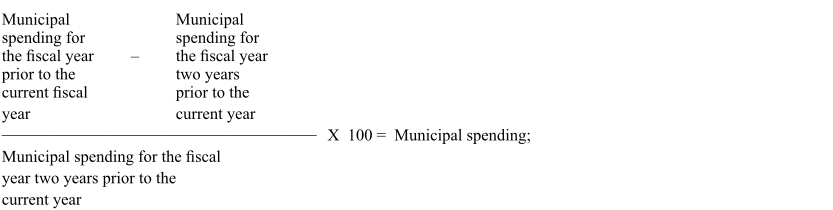
“Municipal spending” does not include expenditures for debt service, special education, implementation of court orders or arbitration awards, expenditures associated with a major disaster or emergency declaration by the President of the United States, a disaster emergency declaration issued by the Governor pursuant to chapter 517 or any disbursement made to a district pursuant to subsection (c) or (e) of this section, budgeting for an audited deficit, nonrecurring grants, capital expenditures or payments on unfunded pension liabilities.
(5) “Per capita distribution” means:

(6) “Pro rata distribution” means:

(7) “Regional council of governments” means any such council organized under the provisions of sections 4-124i to 4-124p, inclusive;
(8) “Municipal population” means the number of persons in a municipality according to the most recent estimate of the Department of Public Health;
(9) “Total state population” means the number of persons in this state according to the most recent estimate published by the Department of Public Health;
(10) “Weighted mill rate” means a municipality's FY 15 mill rate divided by the average of all municipalities' FY 15 mill rate;
(11) “Weighted mill rate calculation” means per capita distribution multiplied by a municipality's weighted mill rate;
(12) “Sales tax revenue” means the moneys in the account remaining for distribution pursuant to subdivision (3) of subsection (b) of this section;
(13) “District” means any district, as defined in section 7-324;
(14) “Secretary” means the Secretary of the Office of Policy and Management;
(15) “Adopted budget expenditures” means any expenditure from a municipality's general fund or any nonbudgeted funds; and
(16) “Capital expenditure” means a nonrecurring capital expenditure of one hundred thousand dollars or more.
(b) There is established an account to be known as the “municipal revenue sharing account”, which shall be a separate, nonlapsing account. The account shall contain any moneys required by law to be deposited in the account. The secretary shall set aside and ensure availability of moneys in the account in the following order of priority and shall transfer or disburse such moneys as follows:
(1) For the fiscal years ending June 30, 2022, and June 30, 2023, moneys sufficient to make motor vehicle property tax grants payable to municipalities pursuant to subsection (c) of this section shall be expended not later than August first annually by the secretary;
(2) For the fiscal years ending June 30, 2022, and June 30, 2023, moneys sufficient to make the grants payable pursuant to subsection (d) of section 12-18b, subdivisions (1) and (3) of subsection (e) of section 12-18b, subsection (b) of section 12-19b and subsections (b) and (c) of section 12-20b shall be expended by the secretary; and
(3) For the fiscal years ending June 30, 2022, and June 30, 2023, moneys in the account remaining shall be expended annually by the secretary for the purposes of the municipal revenue sharing grants established pursuant to subsection (d) of this section. Any such moneys deposited in the account for municipal revenue sharing grants, including moneys accrued to the account during each fiscal year but received after the end of such fiscal year, shall be distributed to municipalities not later than October first following the end of each fiscal year. Any municipality may apply to the Office of Policy and Management on or after July first for early disbursement of a portion of such grant. The Office of Policy and Management may approve such an application if it finds that early disbursement is required in order for a municipality to meet its cash flow needs. No early disbursement approved by said office may be issued later than September thirtieth.
(c) (1) For the fiscal year ending June 30, 2022, motor vehicle property tax grants to municipalities that impose mill rates on real property and personal property other than motor vehicles greater than 45 mills or that, when combined with the mill rate of any district located within the municipality, impose mill rates greater than 45 mills, shall be made in an amount equal to the difference between the amount of property taxes levied by the municipality and any district located within the municipality on motor vehicles for the assessment year commencing October 1, 2017, and the amount such levy would have been if the mill rate on motor vehicles for said assessment year was equal to the mill rate imposed by such municipality and any district located within the municipality on real property and personal property other than motor vehicles.
(2) Not later than fifteen calendar days after receiving a property tax grant pursuant to this section, the municipality shall disburse to any district located within the municipality the amount of any such property tax grant that is attributable to the district.
(3) For the fiscal year ending June 30, 2023, and each fiscal year thereafter, motor vehicle property tax grants shall be made to:
(A) Municipalities that imposed mill rates greater than 32.46 mills on real property and personal property other than motor vehicles for the preceding fiscal year, in an amount equal to the difference between (i) the amount of property taxes the municipality would have levied on motor vehicles for the preceding fiscal year if the mill rate imposed on motor vehicles for such year was 32.46 mills, and (ii) the amount of property taxes the municipality would have levied on motor vehicles for the preceding fiscal year if the mill rate imposed on motor vehicles for such year was equal to the mill rate imposed on real property and personal property other than motor vehicles for such year; and
(B) Districts that imposed mill rates that, when combined with the mill rate of the municipality in which the district is located, were greater than 32.46 mills on real property and personal property other than motor vehicles for the preceding fiscal year, in an amount equal to the difference between (i) the amount of property taxes the district would have levied on motor vehicles for the preceding fiscal year if the mill rate imposed on motor vehicles for such year, when combined with the mill rate imposed on motor vehicles for such year by the municipality in which the district is located, was 32.46 mills, and (ii) the amount of property taxes the district would have levied on motor vehicles for the preceding fiscal year if the mill rate imposed on motor vehicles for such year, when combined with the mill rate imposed on motor vehicles for such year by the municipality in which the district is located, was equal to the mill rate imposed by the district on real property and personal property other than motor vehicles for such year.
(d) For the fiscal year ending June 30, 2020, and each fiscal year thereafter, each municipality shall receive a municipal revenue sharing grant as follows:
(1) (A) A municipality having a mill rate at or above twenty-five shall receive the per capita distribution or pro rata distribution, whichever is higher for such municipality.
(B) Such grants shall be increased by a percentage calculated as follows:
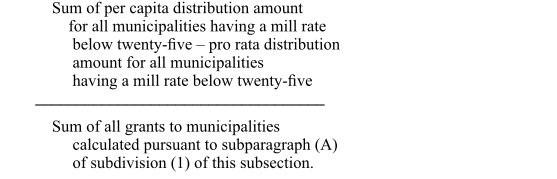
(C) Notwithstanding the provisions of subparagraphs (A) and (B) of this subdivision, Hartford shall receive not more than 5.2 per cent of the municipal revenue sharing grants distributed pursuant to this subsection; Bridgeport shall receive not more than 4.5 per cent of the municipal revenue sharing grants distributed pursuant to this subsection; New Haven shall receive not more than 2.0 per cent of the municipal revenue sharing grants distributed pursuant to this subsection and Stamford shall receive not more than 2.8 per cent of the equalization grants distributed pursuant to this subsection. Any excess funds remaining after such reductions in payments to Hartford, Bridgeport, New Haven and Stamford shall be distributed to all other municipalities having a mill rate at or above twenty-five on a pro rata basis according to the payment they receive pursuant to this subdivision; and
(2) A municipality having a mill rate below twenty-five shall receive the per capita distribution or pro rata distribution, whichever is less for such municipality.
(3) For the purposes of this subsection, “mill rate” means the mill rate for real property and personal property other than motor vehicles.
(e) Except as provided in subsection (c) of this section, a municipality may disburse any municipal revenue sharing grant funds to a district within such municipality.
(f) (1) Except as provided in subdivisions (2) and (3) of this subsection, for the fiscal year ending June 30, 2018, and each fiscal year thereafter, the amount of the grant payable to a municipality in any year in accordance with subsection (d) of this section shall be reduced if such municipality increases its adopted budget expenditures for such fiscal year above a cap equal to the amount of adopted budget expenditures authorized for the previous fiscal year by 2.5 per cent or more or the rate of inflation, whichever is greater. Such reduction shall be in an amount equal to fifty cents for every dollar expended over the cap set forth in this subsection. Each municipality shall annually certify to the secretary, on a form prescribed by the secretary, whether such municipality has exceeded the cap set forth in this subsection, and if so, the amount by which the cap was exceeded by such municipality, except that in any fiscal year for which the secretary publishes a list of payments made to municipalities by state agencies on the Internet web site of the Office of Policy and Management, such certification shall not be required.
(2) For the fiscal year ending June 30, 2018, and each fiscal year thereafter, the amount of the grant payable to a municipality in any year in accordance with subsection (d) of this section shall not be reduced in the case of a municipality whose adopted budget expenditures exceed the cap set forth in subdivision (1) of this subsection by an amount proportionate to any increase to its municipal population from the previous fiscal year, as determined by the secretary.
(3) For the fiscal year ending June 30, 2026, the amount of the grant payable to a municipality in accordance with subsection (d) of this section shall not be reduced in the case of a municipality whose adopted budget expenditures exceed the cap set forth in subdivision (1) of this subsection.
(g) For the fiscal years ending June 30, 2020, to June 30, 2023, inclusive, the amount of the grant payable to a municipality in any year in accordance with subsection (d) of this section shall be reduced proportionately if the total of such grants in such year exceeds the amount available for such grants in the municipal revenue sharing account established pursuant to subsection (b) of this section.
(P.A. 11-6, S. 96; 11-61, S. 44; 11-239, S. 17; P.A. 12-104, S. 10; P.A. 15-244, S. 207; June Sp. Sess. P.A. 15-5, S. 110, 111, 494; Dec. Sp. Sess. P.A. 15-1, S. 31; May Sp. Sess. P.A. 16-2, S. 42; May Sp. Sess. P.A. 16-3, S. 189; June Sp. Sess. P.A. 17-2, S. 700; June Sp. Sess. P.A. 17-4, S. 21; P.A. 18-81, S. 24; P.A. 21-3, S. 6; June Sp. Sess. P.A. 21-2, S. 181, 444; P.A. 22-74, S. 11; 22-118, S. 94, 414; P.A. 23-204, S. 79, 80; P.A. 25-3, S. 2; 25-110, S. 6.)
History: P.A. 11-6 effective July 1, 2011; P.A. 11-61 designated existing Subsec. (b) as Subsec. (b)(1) and amended same by removing reference to Sec. 32-9s and replacing general provision re grants with list of grant amounts to each municipality, added Subsec. (b)(2) re reduction of grant amounts, added Subsec. (b)(3) re treatment of overpayments and amended Subsec. (c) to specify sources of numbers to be used in the formula under Sec. 3-55j(e), effective July 1, 2011; P.A. 11-239 amended Subsec. (b)(3) to change reference to Sec. 12-94b to the revision of 1958, revised to January 1, 2011, effective July 1, 2011; P.A. 12-104 amended Subsec. (b) to change grant payment to Franklin from $413,545 to $18,317 and grand total from $50,271,099 to $49,875,871 in Subdiv. (1) and to add Subdiv. (4) re additional payments to Ledyard and Montville, effective June 8, 2012; P.A. 15-244 added new Subsec. (a) re definitions, redesignated existing Subsec. (a) as new Subsec. (b) and amended same by establishing order for disbursement of account moneys, deleted former Subsec. (b) re manufacturing transition grants, deleted former Subsec. (c) re distribution of moneys remaining in account, added new Subsec. (c) re motor vehicle property tax grants, added Subsec. (d) re municipal revenue sharing grants for fiscal year ending June 30, 2017, added Subsec. (e) re regional services grants, added Subsec. (f) re municipal revenue sharing grants for fiscal year ending June 30, 2018, and each fiscal year thereafter, added Subsec. (g) re disbursement of municipal revenue sharing grants to districts, added Subsec. (h) re reduction of municipal revenue sharing grants when municipality exceeds spending cap and added Subsec. (i) re proportionate reduction of municipal revenue sharing grants when grant total exceeds amount available in account; June Sp. Sess. P.A. 15-5 amended Subsec. (a) by adding Subdiv. (13) defining “district”, amended Subsec. (b) by making provisions applicable to fiscal year ending June 30, 2018, in Subdiv. (4), by deleting provisions re distribution of moneys for regional services grants on a per capita basis in Subdiv. (5) and by making provisions applicable to fiscal year ending June 30, 2019, and each fiscal year thereafter in Subdiv. (6), amended Subsec. (c) by making provisions applicable to combined mill rate of municipality and any district located within the municipality and requiring municipality to disburse district's share not later than 15 calendar days after receiving property tax grant, amended Subsec. (d) by making provisions applicable to fiscal year ending June 30, 2018, and replacing list of grant amounts, amended Subsec. (e) by adding provision re grants to regional councils of governments to be calculated by formula determined by secretary, amended Subsec. (f) by making provisions applicable to fiscal year ending June 30, 2019, amended Subsec. (h) by redefining “municipal spending”, and made conforming and technical changes throughout; Dec. Sp. Sess. P.A. 15-1 amended Subsec. (a) by adding Subdiv. (14) defining “secretary”, amended Subsec. (b) by adding provision re secretary to set aside and ensure availability of moneys in the account in order of priority, deleting provision re amount for fiscal year ending June 30, 2017, and adding provision re transfer not later than April 15th in Subdiv. (1), deleting former Subdiv. (2) re transfers for fiscal year ending June 30, 2017, and each fiscal year thereafter, redesignating existing Subdiv. (3) as Subdiv. (2) and amending same by adding “payable” and “not later than August first”, adding new Subdiv. (3) re transfers for fiscal year ending June 30, 2017, and each fiscal year thereafter, adding reference to June 30, 2019, and provision re expenditure not later than October 31st annually in Subdiv. (4), adding new Subdiv. (5) re transfer of $10,000,000 for fiscal year ending June 30, 2017, redesignating existing Subdiv. (5) as Subdiv. (6), and redesignating existing Subdiv. (6) as Subdiv. (7) and amending same by changing “2019” to “2020”, amended Subsec. (d) by adding reference to June 30, 2019, amended Subsec. (f) by changing “2019” to “2020”, amended Subsec. (h) by adding reference to Subsec. (d), amended Subsec. (i) by adding “For the fiscal year ending June 30, 2020, and each fiscal year thereafter,” and deleting reference to Subsec. (d), and made conforming and technical changes, effective December 29, 2015; May Sp. Sess. P.A. 16-2 amended Subsec. (a) by adding “, unless otherwise specified,” in Subdiv. (2), redefining “municipality” in Subdiv. (3), replacing references to town with references to municipal in Subdivs. (5) and (8), and making a conforming change in Subdiv. (12), amended Subsec. (b) by replacing “June 30, 2017” with “June 30, 2018” in Subdivs. (2) and (3), deleting “June 30, 2017,” and adding “subdivision (2) of” in Subdiv. (4), deleting former Subdiv. (5) re transfer of $10,000,000 for fiscal year ending June 30, 2017, deleting former Subdiv. (6)(A) re expenditure of $3,000,000 for fiscal year ending June 30, 2017, redesignating existing Subdiv. (6)(B) as new Subdiv. (5), redesignating existing Subdiv. (7) as new Subdiv. (6) and amending same by replacing “town” with “municipality”, amended Subsec. (c) by deleting Subdiv. (1) designator, replacing “June 30, 2017” with “June 30, 2018, and each fiscal year thereafter” and adding “on real property and personal property other than motor vehicles” in provision re mill rates, deleting former Subdiv. (2) re motor vehicle property tax grants to municipalities for fiscal year ending June 30, 2018, and each fiscal year thereafter, substantially revised Subsec. (d) re municipal revenue sharing grants, and amended Subsec. (e) by adding provision re expenditure of $3,000,000 for fiscal year ending June 30, 2017, and making a technical change, effective July 1, 2016; May Sp. Sess. P.A. 16-3 amended Subsec. (e) by adding provision re 35 per cent of grant moneys awarded to regional councils of governments for regional education service center purposes for fiscal year ending June 30, 2018, and each fiscal year thereafter and making a technical change, amended Subsec. (f) by adding Subdiv. (3) defining “mill rate”, and amended Subsec. (h) by designating existing provisions as Subdiv. (1) and amending same by replacing “For” with “Except as provided in subdivision (2) of this subsection, for”, replacing “general budget expenditures” with “adopted budget expenditures”, designating existing provision re exclusions from municipal spending as Subpara. (A) and adding “budgeting for an audited deficit, nonrecurring grants, capital expenditures or payments on unfunded pension liabilities”, adding Subparas. (B) and (C) defining “adopted budget expenditures” and “capital expenditure”, respectively, and adding Subdiv. (2) re grant reduction prohibition for certain municipalities for fiscal year ending June 30, 2018, and each fiscal year thereafter, effective July 1, 2016; June Sp. Sess. P.A. 17-2 amended Subsec. (c) by designating existing provisions re motor vehicle property tax grants to municipalities that impose mill rates on real property and personal property other than motor vehicles greater than the maximum mill rate as Subdiv. (1) and amending same by replacing maximum mill rate of 32 mills to maximum mill rate of 39 mills and deleting “and each fiscal year thereafter,”, adding Subdiv. (2) re motor vehicle property grants for fiscal year ending June 30, 2019, and each fiscal year thereafter, and designating existing provision re disbursement of property tax grant pursuant to this section as Subdiv. (3), effective October 31, 2017; June Sp. Sess. P.A. 17-4 amended Subsec. (b) by adding new Subdiv. (6) re supplemental motor vehicle property tax grants and redesignating existing Subdiv. (6) as Subdiv. (7), amended Subsec. (c) by adding new Subdiv. (3) re supplemental motor vehicle property tax grant requirements and redesignating existing Subdiv. (3) as Subdiv. (4), and made technical and conforming changes, effective November 21, 2017; P.A. 18-81 amended Subsec. (c) by replacing “2019” and “2013” with “2020” and “2016”, respectively, in Subdiv. (2) and deleting “and each fiscal year thereafter,” in Subdiv. (3), effective July 1, 2018; P.A. 21-3 amended Subsec. (b)(3) by replacing “2018” with “2022”, deleting reference to select payment in lieu of taxes grant account and adding reference to Sec. 12-18b(d) re moneys to be expended for grants, effective July 1, 2021; June Sp. Sess. P.A. 21-2 amended Subsec. (b) by deleting former Subdiv. (5) re regional services grants for fiscal year ending June 30, 2018, and each fiscal year thereafter and redesignating existing Subdivs. (6) and (7) as Subdivs. (5) and (6), deleted former Subsec. (d) re municipal revenue sharing grants for fiscal year ending June 30, 2017, and municipal sharing grants for fiscal years ending June 30, 2018, and June 30, 2019, deleted former Subsec. (e) re regional services grants for fiscal year ending June 30, 2017, and each fiscal year thereafter, use of such grants, approval of expenditures from such grants, and submission of biennial reports, redesignated existing Subsecs. (f) to (i) as Subsecs. (d) to (g), and substantially revised Subsec. (b) re transfer or disbursement of moneys from account, amended Subsec. (c) by deleting former Subdiv. (1) re motor vehicle property tax grants for fiscal year ending June 30, 2018, redesignating existing Subdiv. (2) as Subdiv. (1) and amending same to replace “2020” with “2022”, “2016” with “2017”, and “45 mills” with provision re mill rate imposed on real property and personal property other than motor vehicles, deleting former Subdiv. (3) re municipality that imposed mill rate for real and personal property of more than 39 mills during fiscal year ending June 30, 2017, and redesignating Subdiv. (4) as Subdiv. (2), deleted former Subsec. (d) and redesignated existing Subsecs. (e) to (i) as Subsecs. (d) to (h) (codified by the Revisors as Subsecs. (d) to (g) per S. 181), and made conforming changes, effective July 1, 2021; P.A. 22-74 amended Subsec. (f)(1) by adding exception to municipal annual certification requirement for fiscal years for which Secretary of the Office of Policy and Management publishes list of payments on Internet web site of Office of Policy and Management, effective July 1, 2022; P.A. 22-118 amended Subsec. (b)(3) by replacing provision re moneys deposited in the account to be distributed the following October first or January first with provision re moneys deposited in account including moneys accrued during the fiscal year to be distributed not later than October first following the end of each fiscal year, effective July 1, 2022, and amended Subsec. (c) by deleting “and each fiscal year thereafter,” in Subdiv. (1) and adding Subdiv. (3) re motor vehicle property tax grants for fiscal year ending June 30, 2023, and each fiscal year thereafter, effective May 7, 2022; P.A. 23-204 amended Subsec. (b)(1) to (3) by replacing “For the fiscal year ending June 30, 2022, and each fiscal year thereafter” with “For the fiscal years ending June 30, 2022, and June 30, 2023”, and amended Subsec. (g) by replacing “For the fiscal year ending June 30, 2022, and each fiscal year thereafter” with “For the fiscal years ending June 30, 2020, to June 30, 2023, inclusive”, effective July 1, 2023; P.A. 25-3 amended Subsec. (a) to consolidate definitions previously contained in Subsec. (f), added Subsec. (f)(3) re grants payable to municipalities that exceed the spending cap for the fiscal year ending June 30, 2026, and made technical changes; P.A. 25-110 amended Subsec. (b) to delete reference to General Fund and make a technical change, effective July 1, 2025.
| (Return to Chapter Table of Contents) |
(Return to List of Chapters) |
(Return to List of Titles) |
Sec. 4-66n. Municipal reimbursement and revenue account. Distribution of funds. (a) There is established an account to be known as the “municipal reimbursement and revenue account”, which shall be a separate, nonlapsing account. The account shall contain any moneys required by law to be deposited in the account.
(b) Moneys transferred to the account in accordance with section 87 of public act 13-247* shall be expended by the Office of Policy and Management as follows: (1) For the Nutmeg Network, two million one hundred four thousand dollars; (2) for a tax incidence study, seven hundred thousand dollars; (3) for the universal chart of accounts, two hundred seventy thousand dollars; (4) to audit private providers of special education services, in accordance with section 2-90 and sections 10-91g to 10-91i, inclusive, three hundred sixty-six thousand dollars; (5) for the Department of Education, to conduct the study described in section 4 of public act 16-144*, two hundred fifty thousand dollars; and (6) to promote and facilitate the implementation of the most efficient, high-quality, cost-effective and responsive service delivery, two hundred fifty thousand dollars. Such moneys for the universal chart of accounts may be used to reimburse expenses incurred on or after July 1, 2013.
(P.A. 13-247, S. 328; P.A. 15-169, S. 1; P.A. 16-144, S. 5; P.A. 19-117, S. 229; P.A. 25-110, S. 7.)
*Note: Section 87 of public act 13-247 and section 4 of public act 16-144 are special in nature and therefore have not been codified but remain in full force and effect according to their terms.
History: P.A. 13-247 effective June 19, 2013; P.A. 15-169 amended Subsec. (b) by changing “Moneys in the account” to “Moneys transferred to the account in accordance with section 87 of public act 13-247”, deleting specific time frames for expenditures of funds, changing $1,087,000 to $2,174,000 in Subdiv. (1), changing $500,000 to $700,000 in Subdiv. (2), and adding provision re use of funds for universal chart of accounts expense reimbursement, effective July 1, 2015; P.A. 16-144 amended Subsec. (b) to add Subdiv. (4) re audit of private providers of special education services and add Subdiv. (5) re Department of Education to conduct study, effective June 9, 2016; P.A. 19-117 amended Subsec. (b) by changing $2,174,000 to $2,104,000 in Subdiv. (1), changing $450,000 to $270,000 in Subdiv. (3) and adding Subdiv. (6) re implementation of most efficient, high-quality, cost-effective and responsive service delivery, effective July 1, 2019; P.A. 25-110 amended Subsec. (a) by deleting reference to General Fund and making a technical change, effective July 1, 2025.
| (Return to Chapter Table of Contents) |
(Return to List of Chapters) |
(Return to List of Titles) |
Sec. 4-66o. Receivables for anticipated revenue. The Secretary of the Office of Policy and Management may establish receivables for the revenue anticipated pursuant to subparagraph (L) of subdivision (1) of section 12-408 and section 4-66l.
(Dec. Sp. Sess. P.A. 15-1, S. 33; P.A. 25-39, S. 2.)
History: Dec. Sp. Sess. P.A. 15-1 effective December 29, 2015; P.A. 25-39 replaced “subparagraph (K)” with “subparagraph (L)”.
| (Return to Chapter Table of Contents) |
(Return to List of Chapters) |
(Return to List of Titles) |
Sec. 4-66p. Municipal Revenue Sharing Fund. Grants. (a) There is established a fund to be known as the “Municipal Revenue Sharing Fund” which shall be a separate, nonlapsing fund. The fund shall contain any moneys required by law to be deposited in the fund. Moneys in the fund shall be expended by the Secretary of the Office of Policy and Management for the purposes of providing grants pursuant to subsections (c) to (g), inclusive, of this section.
(b) For the fiscal year ending June 30, 2017, ten million dollars shall be transferred from such fund not later than April fifteenth for the purposes of grants under section 10-262h.
(c) For the fiscal year ending June 30, 2024, and each fiscal year thereafter, moneys sufficient to make motor vehicle property tax grants payable to municipalities pursuant to subsection (c) of section 4-66l shall be expended not later than August first annually by the secretary.
(d) For the fiscal year ending June 30, 2024, and each fiscal year thereafter, moneys sufficient to make the grants payable pursuant to subsections (d) and (e) of section 12-18b shall be expended by the secretary.
(e) (1) For the fiscal year ending June 30, 2024, and each fiscal year thereafter, each municipality or district listed below shall receive the following supplemental revenue sharing grant payable not later than October thirty-first annually:
Grantee |
Grant Amount |
Andover |
43,820 |
Ansonia |
- |
Ashford |
44,498 |
Avon |
142,054 |
Barkhamsted |
- |
Beacon Falls |
- |
Berlin |
258,989 |
Bethany |
26,746 |
Bethel |
- |
Bethlehem |
40,552 |
Bloomfield |
291,027 |
Bolton |
11,053 |
Bozrah |
- |
Branford |
- |
Bridgeport |
6,059,559 |
Bridgewater |
- |
Bristol |
234,651 |
Brookfield |
272,396 |
Brooklyn |
- |
Burlington |
34,417 |
Canaan |
24,132 |
Canaan Fire District |
100,000 |
Canterbury |
94,624 |
Canton |
- |
Chaplin |
34,779 |
Cheshire |
241,134 |
Chester |
- |
Clinton |
288,473 |
Colchester |
134,167 |
Colebrook |
- |
Columbia |
28,393 |
Cornwall |
- |
Coventry |
113,156 |
Cromwell |
- |
Danbury |
1,218,855 |
Darien |
- |
Deep River |
- |
Derby |
205,327 |
Durham |
244,059 |
Eastford |
- |
East Granby |
- |
East Haddam |
- |
East Hampton |
120,397 |
East Hartford |
200,959 |
East Haven |
- |
East Lyme |
524,097 |
Easton |
- |
East Windsor |
- |
Ellington |
- |
Enfield |
- |
Essex |
- |
Fairfield |
191,245 |
Farmington |
802,461 |
Franklin |
25,666 |
Glastonbury |
385,930 |
Goshen |
- |
Granby |
- |
Greenwich |
- |
Griswold |
- |
Groton |
466,668 |
Guilford |
496,560 |
Haddam |
- |
Hamden |
1,646,236 |
Hampton |
28,585 |
Hartford |
15,792,632 |
Hartland |
76,110 |
Harwinton |
39,036 |
Hebron |
125,020 |
Kent |
- |
Killingly |
268,063 |
Killingworth |
155,954 |
Lebanon |
162,740 |
Ledyard |
- |
Lisbon |
139,316 |
Litchfield |
46,905 |
Lyme |
- |
Madison |
175,790 |
Manchester |
780,354 |
Mansfield |
3,291,730 |
Marlborough |
48,977 |
Meriden |
622,306 |
Middlebury |
15,067 |
Middlefield |
14,971 |
Middletown |
- |
Milford |
1,130,086 |
Monroe |
443,723 |
Montville |
20,897 |
Morris |
- |
Naugatuck |
283,399 |
New Britain |
2,176,332 |
New Canaan |
- |
New Fairfield |
265,666 |
New Hartford |
- |
New Haven |
16,921,822 |
Newington |
- |
New London |
1,112,913 |
New Milford |
- |
Newtown |
267,960 |
Norfolk |
9,911 |
North Branford |
152,031 |
North Canaan |
11,334 |
North Haven |
- |
North Stonington |
- |
Norwalk |
1,780,046 |
Norwich |
210,834 |
Old Lyme |
- |
Old Saybrook |
- |
Orange |
221,467 |
Oxford |
267,543 |
Plainfield |
- |
Plainville |
- |
Plymouth |
- |
Pomfret |
23,434 |
Portland |
- |
Preston |
- |
Prospect |
73,271 |
Putnam |
71,039 |
Redding |
57,277 |
Ridgefield |
117,659 |
Rocky Hill |
65,602 |
Roxbury |
- |
Salem |
132,694 |
Salisbury |
- |
Scotland |
13,960 |
Seymour |
- |
Sharon |
- |
Shelton |
- |
Sherman |
- |
Simsbury |
- |
Somers |
240,198 |
Southbury |
74,062 |
Southington |
- |
South Windsor |
57,854 |
Sprague |
- |
Stafford |
- |
Stamford |
1,846,049 |
Sterling |
- |
Stonington |
218,992 |
Stratford |
- |
Suffield |
206,051 |
Thomaston |
- |
Thompson |
4,459 |
Tolland |
322,977 |
Torrington |
72,539 |
Trumbull |
604,706 |
Union |
- |
Vernon |
330,755 |
Voluntown |
- |
Wallingford |
- |
Warren |
- |
Washington |
- |
Waterbury |
5,582,559 |
Waterford |
- |
Watertown |
- |
Westbrook |
- |
West Hartford |
- |
West Haven |
- |
Weston |
70,181 |
Westport |
66,133 |
Wethersfield |
- |
Willington |
- |
Wilton |
93,135 |
Winchester |
105,432 |
Windham |
1,349,376 |
Windsor |
357,943 |
Windsor Locks |
150,116 |
Wolcott |
136,938 |
Woodbridge |
120,477 |
Woodbury |
- |
Woodstock |
- |
TOTAL |
74,672,468 |
(2) If the total of grants payable to each municipality and district in accordance with subdivision (1) of this subsection exceeds the amount appropriated for the purposes of said subdivision, the amount of the grant payable to each municipality and district shall be reduced proportionately.
(f) In addition to the payments due to municipalities and districts under subsection (e) of this section, the following amounts shall be due to the following:
(1) The city of Bridgeport shall be due five million dollars, annually;
(2) The town of Voluntown, with respect to any state-owned forest, shall be due sixty thousand dollars, annually, for reimbursement to municipalities for loss of taxes on private tax-exempt property;
(3) The town of Branford, with respect to the Connecticut Hospice located in said town, shall be due one hundred thousand dollars, annually, for reimbursement to municipalities for loss of taxes on private tax-exempt property; and
(4) The city of New London, with respect to the United States Coast Guard Academy located in said city, shall be due one million dollars, annually, for reimbursement to municipalities for loss of taxes on private tax-exempt property.
(g) (1) For the fiscal year ending June 30, 2024, and each fiscal year thereafter, moneys remaining in the Municipal Revenue Sharing Fund, including moneys accrued to the fund during such fiscal year but received after the end of such fiscal year, shall be expended not later than October first following the end of each such fiscal year by the secretary for the purposes of the municipal revenue sharing grants established pursuant to subsection (d) of section 4-66l.
(2) The amount of the grant payable to a municipality in any year in accordance with subdivision (1) of this subsection shall be reduced proportionately in the event that the total of such grants in such year exceeds the amount available for such grants in the Municipal Revenue Sharing Fund established pursuant to subsection (a) of this section.
(May Sp. Sess. P.A. 16-2, S. 41; P.A. 23-204, S. 75; P.A. 25-174, S. 190.)
History: May Sp. Sess. P.A. 16-2 effective June 2, 2016; P.A. 23-204 made a conforming change in Subsec. (a) and added Subsec. (c) re payment of motor vehicle property tax grants pursuant to Sec. 4-66l(c), Subsec. (d) re grants payable pursuant to Sec. 12-18b(d) and (e), Subsec. (e) re supplemental revenue sharing grants, and Subsec. (f) re expenditure of moneys remaining in fund, effective July 1, 2023; P.A. 25-174 added new Subsec. (f) re amounts due to Bridgeport, Voluntown, Branford and New London, redesignated existing Subsec. (f) as Subsec. (g) and made a conforming change in Subsec. (a), effective July 1, 2025.
| (Return to Chapter Table of Contents) |
(Return to List of Chapters) |
(Return to List of Titles) |
Sec. 4-66aa. Donald E. Williams, Jr. community investment account. Distribution of funds. There is established a separate, nonlapsing account to be known as the “Donald E. Williams, Jr. community investment account”. The account shall contain any moneys required by law to be deposited in the account. The funds in the account shall be distributed every three months as follows: (1) Twelve dollars of each fee credited to said account shall be deposited into the agriculture sustainability account established pursuant to section 4-66cc and, then, of the remaining funds, (2) twenty-five per cent to the Department of Economic and Community Development to use as follows: (A) Four hundred seventy-five thousand dollars, annually, to supplement the technical assistance and preservation activities of the Connecticut Trust for Historic Preservation, established pursuant to special act 75-93, and (B) the remainder to supplement historic preservation activities as provided in sections 10-409 to 10-415, inclusive; (3) twenty-five per cent to the Department of Housing to supplement new or existing affordable housing programs; (4) twenty-five per cent to the Department of Energy and Environmental Protection for municipal open space grants; and (5) twenty-five per cent to the Department of Agriculture to use as follows: (A) Six hundred twenty-five thousand dollars annually for the agricultural viability grant program established pursuant to section 22-26j; (B) six hundred twenty-five thousand dollars annually for the farm transition program established pursuant to section 22-26k; (C) one hundred twenty-five thousand dollars annually to encourage the sale of Connecticut-grown food to schools, restaurants, retailers and other institutions and businesses in the state; (D) ninety-three thousand seven hundred fifty dollars annually for the Connecticut farm link program established pursuant to section 22-26l; (E) fifty-nine thousand three hundred seventy-five dollars annually for the Seafood Advisory Council established pursuant to section 22-455; (F) fifty-nine thousand three hundred seventy-five dollars annually for the Connecticut Farm Wine Development Council established pursuant to section 22-26c; (G) thirty-one thousand two hundred fifty dollars annually to the Connecticut Food Policy Council established pursuant to section 22-456; and (H) the remainder for farmland preservation programs pursuant to chapter 422. Each agency receiving funds under this section may use not more than ten per cent of such funds for administration of the programs for which the funds were provided.
(P.A. 05-228, S. 6; June Sp. Sess. P.A. 05-3, S. 113; P.A. 09-229, S. 28; June Sp. Sess. P.A. 09-3, S. 69; P.A. 11-48, S. 133; 11-80, S. 1; June 12 Sp. Sess. P.A. 12-2, S. 44; P.A. 14-45, S. 1; P.A. 15-244, S. 93; June Sp. Sess. P.A. 15-5, S. 41; P.A. 25-110, S. 8; 25-168, S. 411.)
History: P.A. 05-228 effective July 1, 2005; June Sp. Sess. P.A. 05-3 changed effective date of P.A. 05-228 to October 1, 2005, effective June 30, 2005; P.A. 09-229 designated existing provisions as Subsec. (a), renamed account the “community investment account” and added Subsec. (b) re distribution of funds from July 1, 2009, until July 1, 2011, effective July 1, 2009; June Sp. Sess. P.A. 09-3 amended Subsec. (b)(4) to require quarterly distribution of funds and add new Subparas. (E) to (H) re distribution of funds to certain organizations, effective September 9, 2009; P.A. 11-48 amended Subsec. (a) by requiring that $10 of each fee be deposited in agriculture sustainability account, replacing “Connecticut Commission on Culture and Tourism” with “Department of Economic and Community Development” and requiring that $47,500 annually be used for Seafood Advisory Council, $47,500 annually be used for Connecticut Farm Wine Development Council and $25,000 annually be used for Connecticut Food Policy Council, effective July 1, 2011 (Revisor's note: “Connecticut Commission on Culture and Tourism” was changed editorially by the Revisors to “Department of Economic and Community Development” in Subsec. (b) to conform with changes made by P.A. 11-48, S. 78); pursuant to P.A. 11-80, “Department of Environmental Protection” was changed editorially by the Revisors to “Department of Energy and Environmental Protection”, effective July 1, 2011; June 12 Sp. Sess. P.A. 12-2 made technical changes in Subsec. (a); P.A. 14-45 deleted Subsec. (a) designator, substituted “Department of Housing” for “Connecticut Housing Finance Authority” in Subdiv. (3) and deleted former Subsec. (b) re distributions from July 1, 2009, until July 1, 2011, effective May 28, 2014; P.A. 15-244 designated existing provisions as Subsec. (a) and added Subsec. (b) to provide that 50 per cent of account deposits from January 1, 2016, to June 30, 2017, be credited to General Fund, and remaining account funds be distributed under Subsec. (a), effective January 1, 2016; June Sp. Sess. P.A. 15-5 amended Subsec. (a)(2)(A) to increase amount of annual funds distributed from the account for the Connecticut Trust for Historic Preservation from $200,000 to $380,000, effective January 1, 2016; P.A. 25-110 amended Subsec. (a) to delete reference to General Fund, effective July 1, 2025; P.A. 25-168 deleted former Subsec. (b) re funds credited to the General Fund, deleted Subsec. (a) designator and amended remaining provision to rename the account as Donald E. Williams, Jr. community investment account, amended Subdiv. (1) by increasing amount from $10 to $12 of fee for agriculture sustainability account, amended Subdiv. (2)(A) to increase amount of annual funds distributed from the account for the Connecticut Trust for Historic Preservation from $380,000 to $475,000 and amended Subdiv. (5) to increase amount of annual funds distributed from the account in Subpara. (A) agricultural viability grant program from $500,000 to $625,000, in Subpara. (B) farm transition program from $500,000 to $625,000, in Subpara. (C) sale of Connecticut-grown food from $100,000 to $125,000, in Subpara. (D) Connecticut farm link program from $75,000 to $93,750, in Subpara. (E) Seafood Advisory Council from $47,500 to $59,375, in Subpara. (F) Connecticut Farm Wine Development Council from $47,500 to $59,375 and in Subpara. (G) Connecticut Food Policy Council from $25,000 to $31,250, effective July 1, 2025.
| (Return to Chapter Table of Contents) |
(Return to List of Chapters) |
(Return to List of Titles) |
Sec. 4-66cc. Agricultural sustainability account. There is established an account to be known as the “agricultural sustainability account”, which shall be a separate, nonlapsing account. The account shall contain any moneys required by law to be deposited in the account. Moneys in the account shall be expended by the Commissioner of Agriculture for the purpose of providing agricultural assistance pursuant to section 22-265b.
(P.A. 09-229, S. 29; P.A. 25-110, S. 9.)
History: P.A. 09-229 effective July 1, 2009; P.A. 25-110 deleted reference to General Fund and made a technical change, effective July 1, 2025.
| (Return to Chapter Table of Contents) |
(Return to List of Chapters) |
(Return to List of Titles) |
Sec. 4-67z. Review of legal obstacles to sharing of high value data. The Chief Data Officer, in consultation with the Attorney General and executive branch agency legal counsel, shall review the legal obstacles to the sharing of high value data of executive branch agencies, inventoried pursuant to section 4-67p, with executive branch agencies and the public.
(P.A. 19-153, S. 1; P.A. 25-168, S. 96.)
History: P.A. 19-153 effective July 9, 2019; P.A. 25-168 deleted Subsec. (a) designator and made technical changes in same and deleted former Subsecs. (b) and (c) re annual report.
| (Return to Chapter Table of Contents) |
(Return to List of Chapters) |
(Return to List of Titles) |
Sec. 4-67ee. Public agency disclosure of personal information. Restricted. Exceptions. Attorney General action. (a) No public agency, as defined in section 1-200, or employee, appointee, officer or official or any other individual acting on behalf of a public agency shall disclose an individual's personal information that is not a matter of public record to any other individual or entity that is not a public agency or employee, appointee, officer or official or any other individual acting on behalf of a public agency, unless such disclosure is:
(1) Authorized in writing by the individual to whom the information pertains, or by the parent or guardian of such individual if the individual is a minor or not legally competent to consent to such disclosure;
(2) Necessary in furtherance of a criminal investigation, unless prohibited by the provisions of section 54-192h;
(3) Otherwise required by state or federal law, including, but not limited to, student and exchange visitor visa sponsorship requirements for public institutions of higher education, or in compliance with a judicial warrant or court order issued by a judge or magistrate of the state or federal judicial branches;
(4) Otherwise permitted by state or federal law governing personal health information, including, but not limited to, the federal Health Insurance Portability and Accountability Act of 1996, P.L. 104-191, as amended from time to time, or regulations adopted thereunder, provided the recipient of such personal information is a covered entity or business associate of a covered entity and such personal information remains subject to all privacy and security requirements of said federal act or regulations;
(5) Otherwise permitted by state law, provided such personal information remains protected by privacy regulations, data use agreements or other rules prohibiting disclosure to unauthorized individuals or entities; or
(6) Customarily publicly disclosed by a public agency for purposes, including, but not limited to, occupational or business license verification, voter registration and research data.
(b) For purposes of this section, personal information means (1) an individual's address, (2) an individual's workplace or hours of work, (3) an individual's school or school hours, or (4) the date, time or place of an individual's hearings, proceedings or appointments with a public agency.
(c) The Attorney General may bring an action against any individual or entity who violates the provisions of this section in the superior court for the judicial district of Hartford for injunction, declaratory judgment or mandamus.
(d) Nothing in this section shall permit the Attorney General to assert any claim against a state agency or a state officer or state employee in such officer's or employee's official capacity, regarding actions or omissions of such state agency, state officer or state employee. If the Attorney General determines that a state officer or state employee is not entitled to indemnification under section 5-141d, the Attorney General may, as it relates to such officer or employee, take any action authorized under this section.
(e) If there is a conflict between any provision of this section and any provision of chapter 14, the provision of chapter 14 shall prevail.
(f) The Attorney General, in consultation with the state's Chief Data Officer, shall provide guidance to public agencies concerning compliance with the provisions of this section.
(Nov. Sp. Sess. P.A. 25-3, S. 14.)
History: Nov. Sp. Sess. P.A. 25-3 effective November 18, 2025.
| (Return to Chapter Table of Contents) |
(Return to List of Chapters) |
(Return to List of Titles) |
Sec. 4-68m. Criminal Justice Policy and Planning Division. Duties. Collaboration with other agencies. Access to information and data. Availability of reports and presentations. (a) There is established a Criminal Justice Policy and Planning Division within the Office of Policy and Management. The division shall be under the direction of an undersecretary.
(b) The division shall promote a more effective and cohesive state criminal justice system by:
(1) Conducting an in-depth analysis of the criminal justice system;
(2) Determining the long-range needs of the criminal justice system and recommending policy priorities for the system;
(3) Identifying critical problems in the criminal justice system and recommending strategies to solve those problems;
(4) Assessing the cost-effectiveness of the use of state and local funds in the criminal justice system;
(5) Recommending means to improve the deterrent and rehabilitative capabilities of the criminal justice system;
(6) Advising and assisting the General Assembly in developing plans, programs and proposed legislation for improving the effectiveness of the criminal justice system;
(7) Making computations of daily costs and comparing interagency costs on services provided by agencies that are a part of the criminal justice system;
(8) Making population computations for use in planning for the long-range needs of the criminal justice system;
(9) Determining long-range information needs of the criminal justice system and acquiring that information;
(10) Cooperating with the Office of the Victim Advocate by providing information and assistance to the office relating to the improvement of crime victims' services;
(11) Serving as the liaison for the state to the United States Department of Justice on criminal justice issues of interest to the state and federal government relating to data, information systems and research;
(12) Measuring the success of community-based services and programs in reducing recidivism;
(13) Developing and implementing a comprehensive reentry strategy as provided in section 18-81w;
(14) Engaging in other activities consistent with the responsibilities of the division; and
(15) Developing and implementing policies for the state-wide delivery of postsecondary educational programs in correctional facilities, including, but not limited to, policies pertaining to federal Pell grants and prison education programs.
(c) In addition to the division's other duties under this section, the division may perform any function described in subsection (b) of this section to promote an effective and cohesive juvenile justice system.
(d) In the performance of its duties under this section, the division shall collaborate with the Department of Correction, the Board of Pardons and Paroles, the Department of Mental Health and Addiction Services and the Department of Emergency Services and Public Protection and consult with the Chief Court Administrator, the executive director of the Court Support Services Division of the Judicial Branch, the Chief State's Attorney and the Chief Public Defender.
(e) (1) At the request of the division, the Department of Correction, the Board of Pardons and Paroles, the Department of Mental Health and Addiction Services, the Department of Emergency Services and Public Protection, the Chief Court Administrator, the executive director of the Court Support Services Division of the Judicial Branch, the Chief State's Attorney, the Chief Public Defender and, in a manner that complies with the requirements of the Family Educational Rights and Privacy Act, 20 USC 1232g, as amended from time to time, each public institution of higher education, as defined in section 10a-57h, shall provide the division with information and data needed by the division to perform its duties under subsection (b) of this section.
(2) The division shall have access to individualized records maintained by the Judicial Branch and the agencies specified in subdivision (1) of this subsection as needed for research purposes. The division, in collaboration with the Judicial Branch and the agencies specified in subdivision (1) of this subsection, shall develop protocols to protect the privacy of such individualized records consistent with state and federal law. The division shall use such individualized records for statistical analyses only and shall not use such records in any other manner that would disclose the identity of individuals to whom the records pertain.
(3) Any information or data provided to the division pursuant to this subsection that is confidential in accordance with state or federal law shall remain confidential while in the custody of the division and shall not be disclosed.
(f) The Office of Policy and Management shall make any report or presentation by the division publicly available on the office's Internet web site, including those required pursuant to sections 4-68n, 4-68o and 4-68p.
(P.A. 05-249, S. 1; P.A. 06-193, S. 2; P.A. 07-217, S. 197; P.A. 11-51, S. 134; June Sp. Sess. P.A. 15-5, S. 488; P.A. 21-97, S. 1; P.A. 25-119, S. 3; 25-168, S. 62, 92.)
History: P.A. 05-249 effective July 1, 2006; P.A. 06-193 amended Subsec. (b) to add new Subdiv. (13) requiring division to develop and implement a comprehensive reentry strategy as provided in Sec. 18-81w and redesignate existing Subdiv. (13) as Subdiv. (14) and added new Subsec. (f) requiring division to submit the plan developed pursuant to Subsec. (b) to the Governor and certain legislative committees not later than January 15, 2007, and to update such plan and submit it to the Governor and said legislative committees not later than January 15, 2009, and biennially thereafter, effective July 1, 2006; P.A. 07-217 amended Subsec. (f) to change the deadline for updating and submitting the updated plan to the Governor and legislative committees from “January 15, 2009, and biennially thereafter” to “February 15, 2009, and biennially thereafter”, effective July 12, 2007; pursuant to P.A. 11-51, “Department of Public Safety” was changed editorially by the Revisors to “Department of Emergency Services and Public Protection” in Subsecs. (d) and (e), effective July 1, 2011; June Sp. Sess. P.A. 15-5 amended Subsec. (b) to add new Subdiv. (8) re review of inventories and analyses submitted under Sec. 4-68s and to redesignate existing Subdivs. (8) to (14) as Subdivs. (9) to (15), effective July 1, 2015; P.A. 21-97 amended Subsec. (b) by deleting “develop a plan to” and “and, to accomplish such plan, shall” and making technical changes and replaced existing Subsec. (f) re submission of plan with new Subsec. (f) re public availability of reports and presentations; P.A. 25-119 amended Subsec. (e)(1) to add public institutions of higher education to require provision of information in compliance with FERPA, effective July 1, 2025; P.A. 25-168 amended Subsec. (b) by deleting former Subdiv. (8) re review of inventories and analyses submitted under Sec. 4-68s and redesignating existing Subdivs. (9) to (15) as Subdivs. (8) to (14), effective June 30, 2025, and further amended same by adding Subdiv. (16), codified by the Revisors as new Subdiv. (15), re postsecondary educational programs, effective July 1, 2025.
| (Return to Chapter Table of Contents) |
(Return to List of Chapters) |
(Return to List of Titles) |
Sec. 4-68r. Definitions. For purposes of this section:
(1) “Cost-beneficial” means the cost savings and benefits realized over a reasonable period of time are greater than the costs of implementation;
(2) “Program inventory” means the (A) compilation of the complete list of all agency programs and activities; (B) identification of those that are evidence-based, research-based and promising; and (C) inclusion of program costs and utilization data;
(3) “Evidence-based” describes a program that (A) incorporates methods demonstrated to be effective for the intended population through scientifically based research, including statistically controlled evaluations or randomized trials; (B) can be implemented with a set of procedures to allow successful replication in the state; (C) achieves sustained, desirable outcomes; and (D) when possible, has been determined to be cost-beneficial;
(4) “Research-based” describes a program or practice that has some research demonstrating effectiveness, such as one tested with a single randomized or statistically controlled evaluation, but does not meet all of the criteria of an evidence-based program; and
(5) “Promising” describes a program or practice that, based on statistical analyses or preliminary research, shows potential for meeting the evidence-based or research-based criteria.
(June Sp. Sess. P.A. 15-5, S. 486; P.A. 25-168, S. 93.)
History: June Sp. Sess. P.A. 15-5 effective July 1, 2015; P.A. 25-168 deleted references to Secs. 4-68s and 4-77c, effective June 30, 2025.
| (Return to Chapter Table of Contents) |
(Return to List of Chapters) |
(Return to List of Titles) |
Sec. 4-68s. Program inventory of agency programs. Pilot program re Pew-MacArthur Results First cost-benefit analysis of state grant programs. Section 4-68s is repealed, effective June 30, 2025.
(June Sp. Sess. P.A. 15-5, S. 487; P.A. 16-28, S. 8; June Sp. Sess. P.A. 17-2, S. 247; June Sp. Sess. P.A. 21-2, S. 24; P.A. 23-204, S. 232; P.A. 25-168, S. 94.)
| (Return to Chapter Table of Contents) |
(Return to List of Chapters) |
(Return to List of Titles) |
Sec. 4-68aa. Social innovation investment enterprise. Social innovation account. (a) As used in this section:
(1) “Secretary” means the Secretary of the Office of Policy and Management, or the secretary's designee;
(2) “Social innovation investment enterprise” means an entity created to coordinate the delivery of preventive social programs by nonprofit service providers, which has the capability of creating a social investment vehicle, entering into outcome-based performance contracts and contracting with service providers;
(3) “Social investment vehicle” means an investment product established by a social innovation investment enterprise to raise private investment capital; and
(4) “Outcome-based performance contract” means a contract entered into between the secretary and a social innovation investment enterprise that establishes outcome-based performance standards for preventive social programs delivered by nonprofit service providers and provides that investors in any social investment vehicle shall receive a return of their investment and earnings thereon only if outcome-based performance standards are met by the social innovation investment enterprise.
(b) The secretary may enter into an outcome-based performance contract with a social innovation investment enterprise for the purpose of accepting a United States Department of Justice fiscal year 2012 Second Chance Act Adult Offender Reentry Program Demonstration Category 2 Implementation grant. The outcome-based performance contract between the secretary and a social innovation investment enterprise may provide for payments from the social innovation account, established pursuant to subsection (d) of this section, to the social innovation investment enterprise or to investors or to both.
(c) The secretary shall comply with the provisions of section 4e-16 relating to privatization contracts when entering into an outcome-based performance contract with a social innovation investment enterprise pursuant to this section.
(d) There is established an account to be known as the “social innovation account”, which shall be a separate, nonlapsing account. The account shall contain any moneys required by law to be deposited in the account. Any interest accruing to the account shall be credited to the account. Moneys may be transferred to the account from the General Fund. Moneys in the account shall be expended by the Secretary of the Office of Policy and Management for the purposes of facilitating the reentry of moderate and high-risk offenders into the community. The secretary may apply for and accept gifts, grants or donations from public or private sources to enable the account to be a source of payments to investors purchasing interests in a social investment vehicle.
(June 12 Sp. Sess. P.A. 12-2, S. 128; P.A. 25-110, S. 10.)
History: June 12 Sp. Sess. P.A. 12-1 effective July 1, 2012; P.A. 25-110 amended Subsec. (d) to delete reference to General Fund and make a technical change, effective July 1, 2025.
| (Return to Chapter Table of Contents) |
(Return to List of Chapters) |
(Return to List of Titles) |
Sec. 4-68cc. Neighborhood Security Fellowship Program. (a) As used in this section, “Neighborhood Security Fellowship Program” or “program” means the pilot program established pursuant to subsection (b) of this section, and “Neighborhood Security Fellows” or “Fellows” means individuals who have been identified and recruited for participation in the Neighborhood Security Fellowship Program pursuant to said subsection.
(b) (1) The Office of Policy and Management shall establish a pilot program to foster neighborhood safety in urban environments and to serve as a blueprint to reduce neighborhood gun violence state-wide. The Secretary of the Office of Policy and Management shall select a municipality that has a population of at least one hundred twenty-four thousand and less than one hundred twenty-five thousand to participate in the Neighborhood Security Fellowship Program.
(2) The chief elected official of the municipality selected by the secretary shall select a nonprofit entity to administer the program, which shall be funded by local, state, federal and private moneys. Such moneys shall be used for the administration and costs of the program, including, but not limited to, salaries, benefits and other compensation for any individuals hired by such nonprofit entity to administer the program and stipends to be paid to Fellows.
(3) The Neighborhood Security Fellowship Program shall engage in, but not be limited to, the following activities and initiatives:
(A) The identification and recruitment into the program of individuals between eighteen and twenty-four years of age who are most likely to be perpetrators or victims of gun violence. Such identification and recruitment shall be accomplished after the execution of all appropriate or necessary waivers, authorizations and releases with the assistance of (i) the local or state police department serving the municipality selected, (ii) the local board of education serving the municipality selected, (iii) the state's attorney serving the judicial district of the municipality selected, (iv) the Court Support Services of the Judicial Branch, and (v) any other state agencies and departments and organizations capable of providing such assistance; and
(B) The coordination of programs, services and activities in which Fellows will participate, including, but not limited to, (i) anger management, (ii) life skills training, (iii) dispute and conflict resolution, (iv) remedial education, (v) leadership development, (vi) character building, (vii) mentoring programs, and (viii) preemployment skills workshops, including career counseling, work-readiness, team building, customer service and entrepreneurial training.
(4) The Neighborhood Security Fellowship Program may engage in (A) the coordination and placement of Fellows in worksite assignments, including (i) local, state and federal government agencies and departments, (ii) state-funded public construction projects within the municipality selected, (iii) private businesses, particularly those receiving assistance from the Small Business Express program established pursuant to section 32-7g or the Subsidized Training and Employment program established pursuant to section 31-3pp, and (iv) nonprofit community-based organizations receiving a grant-in-aid from the state, and (B) the coordination of training placements, including in adult education courses, vocational training programs, higher education courses and apprenticeship programs.
(c) (1) The chief elected official of the municipality selected under subdivision (1) of subsection (b) of this section, in conjunction with the Capital Region Development Authority established pursuant to section 32-601, shall select public construction projects located in the federally designated Promise Zones as Neighborhood Security projects. A state or municipal contract for a Neighborhood Security project shall be awarded only to a bidder that agrees to hire a nonprofit subcontractor that employs Fellows who will be assigned to work at such Neighborhood Security project worksite. The chief elected official of the municipality selected shall (A) determine, in conjunction with the Capital Region Development Authority, any minimum number of Fellows such nonprofit subcontractor shall be required to employ to be eligible to be hired for a Neighborhood Security project, and (B) encourage the hiring of any such nonprofit subcontractor for any other municipal or state-funded public construction project.
(2) Before awarding a contract for a Neighborhood Security project, the state or the municipality shall state in its notice of solicitation for competitive bids or request for proposals or qualifications for such contract that the bidder is required to comply with the provisions of section 4a-60g, the requirements concerning nondiscrimination and affirmative action under section 4a-60 and the provisions under subdivision (1) of this subsection regarding the hiring of a subcontractor. The state or the municipality may inquire whether a bidder is a business enterprise that participates in the Neighborhood Security Fellowship Program and may award preference points to such bidder.
(d) Not later than January 1, 2018, and annually thereafter, if the municipality selected under subdivision (1) of subsection (b) of this section received state funding for the Neighborhood Security Fellowship Program during the previous calendar year, such municipality and the Secretary of the Office of Policy and Management shall jointly submit a report, in accordance with the provisions of section 11-4a, to the joint standing committees of the General Assembly having cognizance of matters relating to the judiciary and appropriations and the budgets of state agencies. Such report shall detail (1) the number of individuals participating in the program during the previous calendar year, (2) any changes in the level of gun-related incidents of violence in the municipality, (3) an evaluation of the programs, services and activities undertaken under subdivision (3) of subsection (b) of this section, (4) the costs of the program during the previous calendar year in both state and private dollars, and (5) any recommendations to expand the program to other municipalities.
(May Sp. Sess. P.A. 16-4, S. 260; P.A. 25-168, S. 207.)
History: May Sp. Sess. P.A. 16-4 effective July 1, 2016; P.A. 25-168 amended Subsec. (c)(2) by deleting reference to Sec. 4a-60a.
| (Return to Chapter Table of Contents) |
(Return to List of Chapters) |
(Return to List of Titles) |
Sec. 4-68ii. Municipal fair share allocations. Section 4-68ii is repealed, effective January 1, 2026.
(P.A. 23-207, S. 18; Nov. Sp. Sess. P.A. 25-1, S. 53.)
| (Return to Chapter Table of Contents) |
(Return to List of Chapters) |
(Return to List of Titles) |
Sec. 4-68aaa. Youth sports grant program for distressed municipalities. (a) As used in this section, (1) “eligible organization” means a nonprofit youth sports organization that provides sports programs and sports activities primarily for children and young adults under eighteen years of age residing in a distressed municipality, and (2) “distressed municipality” has the same meaning as provided in section 32-9p.
(b) (1) There is established a youth sports grant program to provide grants to distressed municipalities for the support of eligible organizations in such municipalities. Such grants shall be disbursed by a distressed municipality to be used by eligible organizations for the expenses of operating sports programs and sports activities in such municipality, including, but not limited to, personnel, equipment, insurance, permits, training and facility fees, renovation of sports facilities and refurbishment of playing fields and to help defray or eliminate participant registration fees.
(2) Priority for grants under the program shall be given to sports programs and sports activities that (A) provide adaptive sports for children and young adults with disabilities, or (B) seek to foster improved outcomes in (i) mental health through social and emotional skills development, (ii) educational achievements through increased attendance and attainment, or (iii) community cohesion by strengthening cooperation, teamwork and leadership.
(3) Commencing with the fiscal year ending June 30, 2027, and annually thereafter, the Secretary of the Office of Policy and Management shall notify the chief elected official of each distressed municipality of the application period for grants under the program to be awarded in such fiscal year. Any such official may apply to the Secretary of the Office of Policy and Management for a grant, provided a new application shall be required each year such official wishes to apply. The application shall be in such form and manner as prescribed by the secretary and shall include information sufficient to allow the secretary to consider the priority criteria set forth in subdivision (2) of this subsection.
(4) Each distressed municipality that is awarded a grant under this section shall, at the close of the fiscal year during which such grant was awarded, submit to the secretary a summary of each eligible organization to which program funds were disbursed and a description of the sports program or sports activity and related expenses for which such funds were used.
(c) Not later than January 1, 2029, and biennially thereafter, the Secretary of the Office of Policy and Management shall submit a report, in accordance with the provisions of section 11-4a, to the joint standing committees of the General Assembly having cognizance of matters relating to children, education and finance, revenue and bonding, on the youth sports grant program for the preceding two fiscal years. The report shall include, but need not be limited to, for each fiscal year, (1) the amounts deposited in the youth sports grant account pursuant to subsection (a) of section 12-867, (2) the municipalities that applied for a grant, the municipalities that were awarded a grant and the total amount of grants awarded, and (3) the summaries provided to the secretary under subdivision (4) of subsection (b) of this section.
(d) There is established an account to be known as the “youth sports grant account”, which shall be a separate, nonlapsing account. The account shall contain any moneys required by law to be deposited in the account and may accept gifts, grants and donations from public or private sources. Moneys in the account shall be expended by the Secretary of the Office of Policy and Management for the purposes of providing grants to distressed municipalities in accordance with the provisions of this section.
(P.A. 24-151, S. 110; P.A. 25-110, S. 11.)
History: P.A. 24-151 effective July 1, 2025; P.A. 25-110 amended Subsec. (d) to delete reference to General Fund and make a technical change, effective July 1, 2025.
| (Return to Chapter Table of Contents) |
(Return to List of Chapters) |
(Return to List of Titles) |
Sec. 4-68bbb. Public transit, pedestrian and bicycle infrastructure grant program. Regional councils of governments. The Secretary of the Office of Policy and Management may, within available appropriations, establish a program to provide grants to regional councils of governments for the development of projects related to public transit infrastructure, bicycle infrastructure or pedestrian infrastructure.
(Nov. Sp. Sess. P.A. 25-1, S. 25.)
History: Nov. Sp. Sess. P.A. 25-1 effective January 1, 2026.
| (Return to Chapter Table of Contents) |
(Return to List of Chapters) |
(Return to List of Titles) |
Sec. 4-68ccc. Loans for water quality project. (a) On and after July 1, 2028, the Secretary of the Office of Policy and Management shall establish and administer a program to provide loans for any municipality that seeks to develop an eligible water quality project, as defined in section 22a-475, for sewer collection and conveyance system improvements. To be eligible to receive such a loan, a municipality that seeks to develop any such project shall comply with the criteria set forth in subsections (b) and (c) of this section. No loan provided pursuant to this section shall exceed one hundred per cent of the eligible water quality project costs. Notwithstanding any section of chapter 446k, any such loan shall be made at an interest rate of one and one-half per cent per annum for a term of twenty years.
(b) To be eligible for a loan pursuant to this section, a municipality shall:
(1) Have a population of not more than fifty thousand people;
(2) Obtain a letter from the Office of Policy and Management that confirms the proposed project is consistent with the state's plan of conservation and development; and
(3) Demonstrate that the eligible sewer collection and conveyance system improvement is or will be funded, designed and constructed in a manner that complies with applicable state and federal statutes and regulations.
(c) In addition to the requirements of subsection (b) of this section, to be eligible to receive a loan pursuant to this section, a municipality shall:
(1) Demonstrate, to the satisfaction of the secretary, that the municipality has taken steps to implement an approved housing growth plan or regional housing growth plan, in accordance with section 8-13bb; or
(2) Be a qualifying transit-oriented community pursuant to section 8-13hh; or
(3) Have an adopted development district established pursuant to a memorandum of agreement with the Connecticut Municipal Development Authority.
(Nov. Sp. Sess. P.A. 25-1, S. 47.)
History: Nov. Sp. Sess. P.A. 25-1 effective January 1, 2026.
| (Return to Chapter Table of Contents) |
(Return to List of Chapters) |
(Return to List of Titles) |
PART II
BUDGET AND APPROPRIATIONS
Sec. 4-73. Recommended appropriations. (a) The budget document shall present in detail for each fiscal year of the ensuing biennium the Governor's recommendation for appropriations to meet the expenditure needs of the state from the General Fund and from all special and agency funds classified by budgeted agencies and showing for each budgeted agency and its subdivisions: (1) A narrative summary describing the agency, the Governor's recommendations for appropriations for the agency, the actual expenditure for the last-completed fiscal year, the estimated expenditure for the current fiscal year, the amount requested by the agency and the Governor's recommendations for appropriations for each fiscal year of the ensuing biennium; (2) a summary of permanent full-time positions by fund, setting forth the number filled and the number vacant as of the end of the last-completed fiscal year, the total number intended to be funded by appropriations without reduction for turnover for the fiscal year in progress, the total number requested and the total number recommended for each fiscal year of the biennium to which the budget relates.
(b) All federal funds expended or anticipated for any purpose shall be accounted for in the budget. The document shall set forth a listing of federal programs, showing the actual expenditures for the last-completed fiscal year, estimated expenditures for the current fiscal year and anticipated funds available for expenditure for each fiscal year of the ensuing biennium. Such federal funds shall be classified by each budgeted agency but shall not include research grants made to educational institutions.
(c) The budget document shall also set forth the budget recommendations for the capital program, to be supported by statements listing the agency's requests and the Governor's recommendations with the statements required by section 4-78.
(d) The appropriations recommended for the legislative branch of the state government shall be the estimates of expenditure requirements transmitted to the Secretary of the Office of Policy and Management by the Joint Committee on Legislative Management pursuant to section 4-77 and the recommended adjustments and revisions of such estimates shall be the recommended adjustments and revisions, if any, transmitted by said committee pursuant to said section.
(e) (1) The appropriations recommended for the Judicial Department shall be the estimates of expenditure requirements transmitted to the Secretary of the Office of Policy and Management by the Chief Court Administrator pursuant to section 4-77 plus the estimates of expenditure requirements for the biennium transmitted by said administrator pursuant to section 51-47c, and the recommended adjustments and revisions of such estimates shall be the recommended adjustments and revisions, if any, transmitted by said administrator pursuant to section 4-77.
(2) The appropriations recommended for the Division of Public Defender Services shall be the estimates of expenditure requirements transmitted to the Secretary of the Office of Policy and Management by the Chief Public Defender pursuant to section 4-77 and the recommended adjustments and revisions of such estimates shall be the recommended adjustments and revisions, if any, transmitted by said administrator pursuant to section 4-77.
(1949 Rev., S. 227; 1951, 1953, June, 1955, S. 77d; 1971, P.A. 1, S. 7; 1972, P.A. 85, S. 3; P.A. 78-298, S. 9, 14; P.A. 79-446, S. 2; 79-557, S. 1; P.A. 81-364, S. 3, 4; 81-376, S. 6, 11; 81-466, S. 1, 4; Nov. Sp. Sess. P.A. 81-13, S. 2, 3; P.A. 82-386, S. 2, 3; P.A. 85-526, S. 4, 5; P.A. 86-305, S. 2; P.A. 87-1, S. 2, 7; 87-539, S. 4, 5; P.A. 91-256, S. 4, 69; June Sp. Sess. P.A. 91-3, S. 37, 168; P.A. 92-126, S. 41, 42, 48; 92-154, S. 5, 6, 23; P.A. 03-132, S. 2; P.A. 10-179, S. 145; P.A. 11-48, S. 31; 11-61, S. 74; P.A. 12-93, S. 2; P.A. 25-168, S. 90.)
History: 1971 act changed language to reflect switch from biennial to annual sessions; 1972 act deleted reference to recommendations of state building program commission; P.A. 78-298 added reference to requirements enumerated in Sec. 4-78; P.A. 79-446 required inclusion of summaries of permanent full-time positions; P.A. 79-557 added requirement of document setting out federal programs and funds by agency, exclusive of research grants to educational institutions; P.A. 81-364 added provision requiring the governor's recommended appropriation for the legislative branch of government to be the same as the estimated expenditure requirements transmitted to the office of policy and management by the legislative management committee under Sec. 4-77; P.A. 81-376 required information gathered under Subdiv. (5) of Subsec. (a) of Sec. 16a-47 to be included in budget document; P.A. 81-466 reorganized provisions and expanded required information in budget document, effective March 1, 1982; Nov. Sp. Sess. P.A. 81-13 added Subsec. (g) re reduction in funds for energy use for budgeted agencies not cooperating in conducting energy audits and implementing required energy conservation measures; P.A. 82-386 added requirements in Subsec. (b) concerning the program evaluation procedure, including the statement of need and the statement by which performance may be measured and schedule concerning the number of budgeted agencies to be subject to the requirements re evaluation of programs and measurement of program effectiveness in 1983 and 1984; P.A. 85-526 added Subsec. (h) re recommendations for modifications to private activity bond allocations; P.A. 86-305 amended Subsec. (d) to require that all federal funds “expended or anticipated” rather than “received” be accounted for in budget, and to delete provision that document, or subsidiary document shall set forth a description citing federal program, amount and purpose for which such federal funds shall be received classified by function or grant program and substitute provisions that document shall set forth listing of federal programs, showing actual expenditures for last-completed fiscal year, estimated expenditures for current fiscal year and anticipated funds available for expenditure for ensuing fiscal year and repealed former Subsec. (g) which provided that document shall set forth a proposed reduction in funds for energy use requested by any budgeted agency occupying a state-owned or leased building and not cooperating with administrative services commissioner and secretary of the office of policy and management in conducting energy audits of such building and implementing audit recommendations or other energy conservation measures required by the secretary (Revisor's note: Subsec. (h), enacted by P.A. 85-526, was relettered editorially as Subsec. (g) by the Revisors); P.A. 87-1 made technical correction; P.A. 87-539 deleted Subsec. (g); P.A. 91-256 in Subsec. (a) added provisions concerning the constituent units of the state system of higher education; June Sp. Sess. P.A. 91-3 amended language to reflect change from annual to biennial budget, and deleted obsolete language in Subsec. (b) which phased in, between March 1, 1982, and March 1, 1984, the number of budgeted agencies to which the provisions of said subsection were applicable, effective July 1, 1992, and first applicable to biennium commencing July 1, 1993; P.A. 92-126 amended Subdiv. (1) of Subsec. (a) to remove language concerning fringe benefits for the constituent units of the state system of higher education, which had been added by P.A. 91-256; P.A. 92-154 attempted to amend language in Subsec. (a) which was deleted by P.A. 92-126; P.A. 03-132 amended Subsec. (c) to designate existing provisions as Subdiv. (1), inserting “energy costs” in schedule of expenditures therein, and to insert new Subdiv. (2) re statement of agency's plans for energy conservation and progress made in the last-completed fiscal year; P.A. 10-179 added Subsec. (g) re recommended judicial branch appropriations, effective July 1, 2010; P.A. 11-48 amended Subsec. (a) by deleting “Part II” designation re budget document and deleting “and a list of agency programs”, deleted former Subsec. (b) re program budgeting, redesignated existing Subsecs. (c) to (g) as Subsecs. (b) to (f), deleted former Subsec. (c)(2) re inclusion of supporting schedule of agency energy costs, amended Subsec. (c) by deleting “program in”, amended Subsec. (d) by deleting “Part II” designation and amended Subsec. (f) by replacing “judicial branch of the state government” with “Judicial Department”, effective July 1, 2011; P.A. 11-61 amended Subsec. (a)(1) by restoring “and a list of agency programs”, restored former Subsec. (b) re program budgeting, restored former Subsecs. (c) to (g) designations and amended Subsec. (g) by designating existing provisions as Subdiv. (1) and adding Subdiv. (2) re recommended appropriations for Division of Public Defender Services, effective July 1, 2011; P.A. 12-93 amended Subsec. (g)(1) to include estimates of expenditure requirements transmitted pursuant to Sec. 51-47c in recommended Judicial Department appropriations, effective July 1, 2012; P.A. 25-168 amended Subsec. (a) by deleting reference to list of agency programs, deleted former Subsec. (b) re required documentation of programs, deleted former Subsec. (c) re supporting schedule of total agency expenditures, redesignated existing Subsecs. (d) to (g) as Subsecs. (b) to (e) and made a technical change in Subsec. (d), effective June 30, 2025.
| (Return to Chapter Table of Contents) |
(Return to List of Chapters) |
(Return to List of Titles) |
Sec. 4-77. Submission of estimates of expenditures by budgeted agencies. Guidelines for standard economic and planning factors and for unit costs for utilities. Statement of revenue and estimated revenue. Financial and personnel status reports. (a) The administrative head of each budgeted agency shall transmit, on or before September first of each even-numbered year, to the Secretary of the Office of Policy and Management, on blanks to be furnished by him not later than the preceding August first, and to the joint standing committee of the General Assembly having cognizance of matters relating to appropriations and the budgets of state agencies, through the Office of Fiscal Analysis, and the standing committee having cognizance of matters relating to such budgeted agency, estimates of expenditure requirements for each fiscal year of the next biennium. On or before September first of each odd-numbered year, said agency head shall transmit recommended adjustments and revisions, if any, of such estimates. The secretary shall set guidelines for standard economic and planning factors and for unit costs, based on source of supply, for fuel oil, electricity, gas and water usage by state agencies, which shall be used by all agencies in the preparation of their estimates of expenditure requirements. The expenditure requirements shall be classified to show expenditures estimated for each major function and activity, project or program of the budgeted agency and its subdivisions, grants or aids to governmental units and capital outlay, and shall include details setting forth the estimated expenditures classified by objects according to a standard plan of classification, with citations of the statutes, if any, relating thereto. Each expenditure requirement for any purpose other than capital outlay involving an increase in or addition to any appropriation of the current fiscal year shall be accompanied by an explanation of the increase or addition. Each expenditure requirement involving a capital outlay shall be accompanied by such supporting schedules of data and explanations as may be required by the secretary.
(b) The administrative head of each budgeted agency shall transmit, on or before September first of each year, to the secretary, in the form required by him, and, on or before November fifteenth of each year, to the joint committee of the General Assembly having cognizance of matters relating to state finance, revenue and bonding, through the Office of Fiscal Analysis, a statement showing in detail the revenue and estimated revenue of the agency for the current fiscal year, an estimate of the revenue from the same or any additional sources for the next fiscal year and, in the even-numbered year, for the next biennium. Said agency head shall include in such statement recommendations as to any changes in the management, practices, regulations or laws governing his budgeted agency affecting the amount of revenue from operations, fees, taxes or other sources or the collection thereof, and any other information required by the secretary.
(c) The administrative head of each budgeted agency shall transmit, to the Office of Fiscal Analysis, copies of the agency's monthly (1) financial status report, and (2) personnel status report.
(d) If any budgeted agency fails to submit estimates required pursuant to this section within the time specified, the Secretary of the Office of Policy and Management shall cause such estimates to be prepared for the budgeted agency.
(1949 Rev., S. 231; 1953, June, 1955, S. 79d; 1971, P.A. 1, S. 8; P.A. 73-679, S. 9, 43; P.A. 74-264, S. 1, 2; P.A. 75-537, S. 24, 55; P.A. 77-614, S. 31, 610; P.A. 79-31, S. 5, 17; P.A. 82-195; 82-314, S. 15, 63; 82-465, S. 3, 5; June Sp. Sess. P.A. 91-3, S. 39, 168; Sept. Sp. Sess. P.A. 09-7, S. 10; P.A. 25-168, S. 91.)
History: 1971 act changed language to reflect switch from biennial to annual sessions; P.A. 73-679 replaced director of the budget with managing director, planning and budgeting division, department of finance and control or his designee; P.A. 74-264 required submission of estimated expenditures to appropriations committee and to committee concerned with matters relating to agency and submission of estimated revenue to finance committee; P.A. 75-537 changed division name to budget and management division and deleted reference to designee; P.A. 77-614 replaced director with secretary of the office of policy and management and required secretary to set guidelines for economic and planning factors for agencies' use; P.A. 79-31 changed formal designation of finance committee; P.A. 82-195 required secretary to set guidelines for unit costs for utilities used by state agencies and divided section into subsections; P.A. 82-314 changed formal designation of appropriations committee and made other technical changes; P.A. 82-465 changed date for submission of expenditure estimates to committees from November fifteenth to September first and required agency heads to transmit copy of monthly financial status report and personnel status report to office of fiscal analysis; June Sp. Sess. P.A. 91-3 amended language to reflect change from annual to biennial budget, effective July 1, 1992, and first applicable to biennium commencing July 1, 1993; Sept. Sp. Sess. P.A. 09-7 added new Subsec. (c) requiring administrative head of each budgeted agency to transmit monthly financial, personnel and nonappropriated moneys status reports to Office of Fiscal Analysis, redesignated existing Subsec. (c) as Subsec. (d) and amended same by deleting provision re financial and personnel status reports and making technical changes, effective October 5, 2009; P.A. 25-168 amended Subsec. (c) by deleting former Subdiv. (3) re nonappropriated moneys accounting and deleting provision re requirements for assessments of status of funds and accounts, effective June 30, 2025.
| (Return to Chapter Table of Contents) |
(Return to List of Chapters) |
(Return to List of Titles) |
Sec. 4-77c. Estimates of expenditure requirements for implementation of evidence-based programs. Section 4-77c is repealed, effective June 30, 2025.
(June Sp. Sess. P.A. 15-5, S. 489; P.A. 25-168, S. 94.)
| (Return to Chapter Table of Contents) |
(Return to List of Chapters) |
(Return to List of Titles) |
Sec. 4-85d. Submission of accounting of federal energy funds. Section 4-85d is repealed, effective June 30, 2025.
(P.A. 82-222, S. 4, 7; June Sp. Sess. P.A. 91-3, S. 43, 168; P.A. 25-168, S. 94.)
| (Return to Chapter Table of Contents) |
(Return to List of Chapters) |
(Return to List of Titles) |
Sec. 4-95b. Transfer of funds to implement improvements to fiscal and related reporting procedures. Section 4-95b is repealed, effective June 30, 2025.
(P.A. 77-572, S. 1, 3; P.A. 25-168, S. 94.)
| (Return to Chapter Table of Contents) |
(Return to List of Chapters) |
(Return to List of Titles) |
Sec. 4-98. Appropriations encumbered by purchase order; current and capital expenditures. Delegation to agency. Purchasing cards. Appointment of purchase card coordinator. Report. (a) Except for such emergency purchases as are made by a budgeted agency under regulations adopted by the Commissioner of Administrative Services, no budgeted agency or any agent thereof shall incur any obligation, by order, contract or otherwise, except by the issue of a purchase order or any other documentation approved by the Comptroller, necessary to process the transaction transmitted by the budgeted agency or its agents to the commissioner and the Comptroller, provided the amount to be charged against the appropriation for a budgeted agency in any year for a purchase order for a current expenditure shall be the amount anticipated to be spent in such year. The amount to be charged against the appropriation for any budgeted agency in any year for a capital expenditure, including an installment purchase, shall be the state's total cost for such capital expenditure unless otherwise authorized by the General Assembly or approved by the Finance Advisory Committee. Upon the receipt of any such purchase order or any other documentation approved by the Comptroller necessary to process the transaction, the Comptroller shall immediately charge the same to the specific appropriation of the budgeted agency issuing the same and certify on the face of the purchase order or approve such other documentation that the purchase is approved and recorded, if the proposed purchase is within the applicable specific appropriation and the budgeted agency has unencumbered funds sufficient to defray such expenditure. In transactions requiring purchase orders, the Comptroller shall promptly transmit such certified purchase order to the vendor named in the purchase order.
(b) Notwithstanding the provisions of subsection (a) of this section, the Comptroller may delegate to any budgeted agency the certification and transmission requirements of purchase orders using authorized electronic methods, provided such agency transmits the information contained in such purchase orders to the Comptroller. Upon receipt of any such electronic transmission, the Comptroller shall immediately charge the same to the specific appropriation of the budgeted agency issuing the same and shall electronically certify that the purchase is approved and recorded, if the proposed purchase is within the applicable specific appropriation and the budgeted agency has unencumbered funds sufficient to defray such expenditure. Upon receipt of the Comptroller's certification, the budgeted agency shall transmit the purchase order to the vendor named in the purchase order.
(c) Notwithstanding the provisions of subsection (a) or (b) of this section, the Comptroller may allow budgeted agencies to use purchasing cards for purchases not exceeding two hundred fifty thousand dollars, unless such agency receives written approval from the Comptroller and the Commissioner of Administrative Services to exceed such amount. No budgeted agency, or any official, employee or agent of a budgeted agency, shall incur any obligation using such a card, except in accordance with the most recent procedures established by the Comptroller. Any such procedures established on or after October 1, 2025, shall include, but need not be limited to, (1) prescribing which employees are eligible to use such card and limitations concerning such use, (2) the types of transactions that are authorized to be charged on the card, (3) limitations on the amounts authorized to be charged for travel, meals and entertainment purposes, (4) the timing of submission of receipts or other reporting concerning the use of such card, (5) a requirement for the digitization of all such receipts or other reporting in CORE-CT or other applicable system, (6) the process for agency approval of reports concerning the use of such card, and (7) specific remedies for noncompliance. Each budgeted agency shall implement such procedures, except a budgeted agency may adopt policies that are more stringent than the requirements of this section or the procedures adopted thereunder.
(d) Each budgeted agency shall appoint an employee to serve as its purchasing card coordinator, who shall be responsible for ensuring the agency's compliance with the procedures adopted under this section and such agency shall inform the Comptroller of such appointment. Such coordinator shall (1) authorize the issuance of purchasing cards to an employee upon the determination by such employee's supervisor that such employee should have such authorization, (2) review receipts or other documentation of transactions made using the card by agency employees and ensure such receipts or documentation are entered into CORE-CT or other applicable system, (3) establish, in accordance with procedures of the Comptroller, dollar limits for the use of such card by agency employees, and (4) deauthorize any employee from using the card who is not providing receipts or other documentation of transactions within the time period established by the agency procedures or who is otherwise not complying with the procedures.
(e) Not later than August 1, 2026, and annually thereafter, each budgeted agency that paid for an expense using a purchasing card during the immediately preceding fiscal year shall report to the Comptroller, on a form prescribed by the Comptroller, concerning its usage of such cards during the preceding fiscal year, and any enforcement of violations of the policies of this section.
(1949 Rev., S. 269; March, 1950, S. 93d; P.A. 74-238; P.A. 77-614, S. 87, 610; P.A. 80-286; P.A. 93-285, S. 3; P.A. 96-156, S. 4; P.A. 98-16, S. 1, 2; P.A. 99-1, S. 1, 2; P.A. 00-25, S. 2; P.A. 01-26, S. 2; P.A. 04-87, S. 1; June 12 Sp. Sess. P.A. 12-1, S. 249; P.A. 25-156, S. 1.)
History: P.A. 74-238 made specific provisions for charging purchase orders against appropriations; P.A. 77-614 replaced commissioner of finance and control and director of purchases with commissioner of administrative services; P.A. 80-286 replaced reference to “full obligation” with words “total cost” with regard to capital expenditures and included approval by finance advisory committee as part of exception to capital expenditures provision; P.A. 93-285 designated existing provisions Subsec. (a) and added new Subsec. (b) regarding comptroller's delegation of powers to agencies and regulatory authority; P.A. 96-156 added Subsec. (c) permitting Comptroller to allow budgeted agencies to use purchasing cards for specified purchases; P.A. 98-16 amended Subsec. (a) by deleting provision that voided nonemergency purchase orders not stamped with Comptroller's certificate, amended Subsec. (b) by substituting “agency copy of the” for “original”, inserted new Subsec. (c) re delegation of certification and transmission of purchase orders using electronic methods and redesignated former Subsec. (c) as Subsec. (d), effective July 1, 1998; P.A. 99-1 amended Subsec. (d) by increasing maximum purchases when using a purchasing card from $1,000 to $10,000, effective July 1, 1999; P.A. 00-25 amended Subsec. (a) by substituting “any other documentation necessary to process the transaction” for “commitment” and making related changes for consistency, deleted former Subsec. (b) re delegation to budgeted agencies of certification and transmission requirements of this section, relettered former Subsec. (c) as Subsec. (b), amending Subsec. (b) by inserting “requirements” and “authorized”, substituting “purchase orders” for “order and commitment” and adding provisions re Comptroller's duties upon receipt of an electronic transmission and agency's duties upon receipt of Comptroller's certification, and relettered former Subsec. (d) as Subsec. (c); P.A. 01-26 made technical changes; P.A. 04-87 amended Subsec. (a) to add provisions re approval of purchase order or other documentation by the Comptroller; June 12 Sp. Sess. P.A. 12-1 amended Subsec. (c) by changing amount of purchases using purchasing cards from $10,000 or less to not exceeding $250,000 and by adding provision re written approval to exceed such amount, effective July 1, 2012; P.A. 25-156 amended Subsec. (c) by adding “the most recent” re procedures, adding Subdivs. (1) to (7) re content of procedures established on or after October 1, 2025, and adding provision re implementation of procedures and adoption of more stringent policies, added Subsec. (d) re appointment of purchasing card coordinator and added Subsec. (e) re annual report to the Comptroller (Revisor's note: In Subsec. (d) the term “purchase card” was changed editorially by the Revisors to “purchasing card” for consistency).
| (Return to Chapter Table of Contents) |
(Return to List of Chapters) |
(Return to List of Titles) |
PART IV
STATE PLANNING
Sec. 4-124s. Regional performance incentive program. (a) For purposes of this section:
(1) “Regional council of governments” means any such council organized under the provisions of sections 4-124i to 4-124p, inclusive;
(2) “Municipality” means a town, city or consolidated town and borough;
(3) “Legislative body” means the board of selectmen, town council, city council, board of aldermen, board of directors, board of representatives or board of the warden and burgesses of a municipality;
(4) “Secretary” means the Secretary of the Office of Policy and Management or the designee of the secretary;
(5) “Regional educational service center” has the same meaning as provided in section 10-282; and
(6) “Employee organization” means any lawful association, labor organization, federation or council having as a primary purpose the improvement of wages, hours and other conditions of employment.
(b) There is established a regional performance incentive program that shall be administered by the Secretary of the Office of Policy and Management. Any regional council of governments, regional educational service center or a combination thereof may submit a proposal to the secretary for: (1) The provision of any service that two or more participating municipalities of such council or local or regional board of education of such regional educational service center may provide on a regional and ongoing basis, (2) the redistribution of grants awarded pursuant to sections 4-66g, 4-66h, 4-66m and 7-536, according to regional priorities, or (3) regional revenue sharing among such participating municipalities pursuant to section 7-148bb. A copy of said proposal shall be sent to the legislators representing said participating municipalities or local or regional boards of education. Any regional educational service center serving a population greater than one hundred thousand may submit a proposal to the secretary for a regional special education initiative.
(c) (1) A regional council of governments or regional educational service center shall submit each proposal in the form and manner the secretary prescribes and shall, at a minimum, provide the following information for each proposal: (A) Service or initiative description; (B) the explanation of the need for such service or initiative; (C) the method of delivering such service or initiative on a regional basis; (D) the organization that would be responsible for regional service or initiative delivery; (E) a description of the population that would be served; (F) the manner in which the proposed regional service or initiative delivery will achieve economies of scale for participating municipalities or boards of education; (G) an estimate of anticipated savings or costs that will not be incurred by participating municipalities during the grant award period and in fiscal years beyond such period; (H) a cost benefit analysis for the provision of the service or initiative by each participating municipality and by the entity or board of education submitting the proposal; (I) a plan of implementation for delivery of the service or initiative on a regional basis that addresses any potential growth or reduction in rates of participation during the grant award period; (J) a resolution endorsing such proposal approved by the governing body of the council or center, which shall include a statement affirming that the council or center shall fund an increasing proportion of the cost of such proposal over the duration of the grant award period, that not less than fifty per cent of the total cost of such proposal shall be funded by the council or center by the end of the grant award period and that the council or center shall fund one hundred per cent of such cost thereafter; (K) a resolution endorsing such proposal approved by the governing body of the council of each planning region in which the service or initiative is to be provided; (L) a copy of an acknowledgment from any employee organization that may be impacted by such proposal that they have been informed of and consulted about the proposal; and (M) an explanation of the potential legal obstacles, if any, to the regional provision of the service or initiative, and how such obstacles will be resolved.
(2) The secretary shall review each proposal and shall award grants for proposals the secretary determines best satisfy the following criteria: (A) The proposed service or initiative will (i) reduce municipal and state costs, (ii) enhance capacity in the delivery of services, or (iii) result in an improvement in the level of service provided when compared to the local delivery of such service, (B) the proposed service or initiative will be available to or benefit all participating members of the regional council of governments or regional educational service center regardless of such members' participation in the grant application process; (C) the proposed service or initiative promotes cooperation among participating members that may lead to a reduction in economic or social inequality; (D) the proposal has been approved by a majority of the members of the council or center; and (E) any employee organizations that may be impacted by such proposal have been informed of and consulted about such proposal, pursuant to this subsection.
(d) Notwithstanding the provisions of sections 7-339a to 7-339l, inclusive, or any other provision of the general statutes, no regional council of governments or regional educational service center or any member municipalities or local or regional boards of education of such councils or centers shall be required to execute an interlocal agreement to implement a proposal submitted pursuant to subsection (c) of this section.
(e) Any board of education awarded a grant for a proposal submitted pursuant to subsection (c) of this section may deposit any cost savings realized as a result of the implementation of the proposed service or initiative into a nonlapsing account pursuant to section 10-248a.
(f) The secretary shall submit to the Governor and the joint standing committee of the General Assembly having cognizance of matters relating to finance, revenue and bonding a report on the grants provided pursuant to this section. Each such report shall (1) include information on the amount of each grant and the potential of each grant for leveraging other public and private investments, and (2) describe any municipal or state cost savings and improved services achieved by means of the program established pursuant to this section. The secretary shall submit a report for the fiscal year commencing July 1, 2011, not later than February 1, 2012, and shall submit a report for each subsequent fiscal year not later than the first day of March in such fiscal year.
(P.A. 07-239, S. 8; P.A. 08-182, S. 11; P.A. 11-61, S. 5; P.A. 13-247, S. 253, 254; P.A. 14-122, S. 4, 5; P.A. 16-144, S. 2; June Sp. Sess. P.A. 21-2, S. 177; P.A. 24-132, S. 7; P.A. 25-133, S. 1.)
History: P.A. 07-239 effective July 1, 2007; P.A. 08-182 amended Subsec. (a) by adding Subdivs. (4) to (6) defining “municipality”, “legislative body” and “secretary”, respectively, amended Subsec. (b) by adding provisions re submission of proposals for joint services or a planning study and deleting prior submittal requirements, replaced former Subsec. (c) with new Subsec. (c) re information to be submitted to secretary and criteria and priority for awarding grants, and amended Subsec. (d) by revising provisions re submittal deadlines and by adding provision requiring report to include information on property tax reductions, effective July 1, 2008; P.A. 11-61 amended Subsec. (b) to add as eligible entities any 2 or more municipalities and economic development districts and to change application dates from December 1, 2007, and December 31, 2008, to December 1, 2011, and December 31, 2011, respectively, amended Subsec. (c)(2) to replace “such member municipalities” with “participating municipalities” and add Subpara. (B) re economic development district, and amended Subsec. (d) to change reporting dates from July 1, 2007, and February 1, 2008, to July 1, 2011, and February 1, 2012, respectively, effective July 1, 2011; P.A. 13-247 amended Subsec. (b) by deleting provision re submission of proposal by specified entities for joint provision of service or services currently provided by municipalities within region of such an entity or contiguous thereto, but not provided on a regional basis, by authorizing specified entities to submit proposal for purposes described in Subdivs. (1) and (2) and by adding Subdiv. (3) re shared information technology services, added new Subsec. (d) re applying for a grant and redesignated existing Subsec. (d) as Subsec. (e), effective June 19, 2013, and amended Subsec. (a) by deleting former Subdivs. (2) and (3) re definitions of “regional council of elected officials” and “regional planning agency” and redesignating existing Subdivs. (4) to (6) as Subdivs. (2) to (4), amended Subsec. (b) by deleting references to regional planning agency and regional council of elected officials and making conforming changes, amended Subsec. (c)(1) by replacing “An entity specified in subsection (a) of this section” with “A regional council of governments or an economic development district” and amended Subsec. (d)(1) by adding provision re including costs to connect at same rate as other government entities, effective January 1, 2015; P.A. 14-122 amended Subsec. (a) to redefine “legislative body” by substituting “board of the warden” for “board of the mayor”; P.A. 16-144 added Subdiv. (5) re definition of “regional educational service center” in Subsec. (a), added references to regional educational service center and added provision authorizing local or regional board of education or regional educational service center serving population greater than 100,000 to submit proposal for regional special education initiative in Subsec. (b), added references to regional educational service center or local or regional board of education and added references to initiative in Subsec. (c) and added “until December 31, 2018” in Subsec. (d), effective June 9, 2016; June Sp. Sess. P.A. 21-2 amended Subsec. (a) by adding Subdiv. (6) defining “employee organization”, amended Subsec. (b) by deleting “On or before December 31, 2011, and annually thereafter, any” and “any two or more municipalities acting through a regional council of governments, any economic development district, any” re submission of proposal to Secretary of the Office of Policy and Management, adding reference to local or regional boards of education, and deleting “local or regional board of education or” re submission of proposal for regional special education initiative, deleting “joint” and “or agency” and adding reference to local or regional board of education in Subdiv. (1), replacing provision re planning study with provision re redistribution of grants according to regional priorities in Subdiv. (2), and replacing “shared information technology services” with provision re regional revenue sharing in Subdiv. (3), amended Subsec. (c) by deleting reference to economic development district and to local or regional board of education in Subdiv. (1), adding “the proposed” and “for participating municipalities or boards of education” in Subdiv. (1)(F), replacing provision re legislative body of each participating municipality with provision re governing body of council or center in Subdiv. (1)(J), adding new Subdiv. (1)(K) re resolution approved by governing body of council, adding Subdiv. (1)(L) re acknowledgment from employee organization, and redesignating existing Subdiv. (1)(K) as Subdiv. (1)(M) and amending same to add “, and how such obstacles will be resolved”, and substantially revising Subdiv. (2) re criteria for awarding grants for proposals, substantially revised Subsec. (d) by replacing provisions re application to fund operating and capital costs to connect with state-wide, high speed, flexible network with prohibition on requiring execution of interlocal agreement, added new Subsec. (e) re depositing cost savings into nonlapsing account, redesignated existing Subsec. (e) as Subsec. (f) and amended same to add Subdiv. (1) designator, add Subdiv. (2) re description of property tax reductions and improved services achieved, delete inclusion in report of property tax reductions achieved and make a technical change, effective July 23, 2021 (Revisor's note: In Subsec. (c), references to Subsec. (c) of this section were changed editorially by the Revisors to “this subsection” for consistency with customary statutory usage); P.A. 24-132 amended Subsec. (b)(1) to change “one” to “two” re participating municipalities or local or regional board of education and change “currently provide on a regional basis” to “may provide on a regional and ongoing basis”, deleted former Subsec. (c)(1)(G) re amount of reduction of mill rates and added new Subsec. (c)(1)(G) re estimate of anticipated savings or costs not incurred, amended Subsec. (c)(1)(I) by adding provision re potential growth or reduction in rates of participation, amended Subsec. (c)(1)(J) by substantially changing requirements for statement included with resolution, amended Subsec. (c)(1)(L) by adding “a copy of”, amended Subsec. (c)(2)(A) by adding clause (i) re municipal and state costs, clause (ii) re capacity in delivery of services, and clause (iii) re improvement in level of service and redesignating existing provisions re benefitting member regardless of participation as new Subsec. (c)(2)(B), deleted former Subsec. (c)(2)(B) re comparing proposal to existing delivery of services, amended Subsec. (c)(2)(D) by deleting provisions re statement of costs funded by council or center, and amended Subsec. (f)(2) by changing “property tax reductions” to “municipal or state cost savings”, effective July 1, 2024; P.A. 25-133 made a technical change in Subsec. (a)(3), effective July 1, 2025.
| (Return to Chapter Table of Contents) |
(Return to List of Chapters) |
(Return to List of Titles) |
PART V
OFFICE OF WORKFORCE STRATEGY
Sec. 4-124w. Office of Workforce Strategy. Responsibilities. (a) There is established an Office of Workforce Strategy. The office shall be within the Department of Economic and Community Development, for administrative purposes only.
(b) The department head of the Office of Workforce Strategy shall be the Chief Workforce Officer, who shall be appointed by the Governor in accordance with the provisions of sections 4-5 to 4-8, inclusive, with the powers and duties therein prescribed. The Chief Workforce Officer shall be qualified by training and experience to perform the duties of the office as set forth in this section and shall have knowledge of publicly funded workforce training programs. The Chief Workforce Officer shall:
(1) Be the principal advisor for workforce development policy, strategy and coordination to the Governor;
(2) Be the lead state official for the development of employment and training strategies and initiatives;
(3) Be the chairperson of the Workforce Cabinet, which shall consist of agencies involved with employment and training, as designated by the Governor pursuant to section 31-3m. The Workforce Cabinet shall meet at the direction of the Governor or the Chief Workforce Officer;
(4) Be the liaison between the Governor, the Governor's Workforce Council, established pursuant to section 31-3h and any local, regional, state or federal organizations and entities with respect to workforce development policy, strategy and coordination, including, but not limited to, implementation of the Workforce Innovation and Opportunity Act of 2014, P.L. 113-128, as amended from time to time;
(5) Develop, and update as necessary, a state workforce strategy in consultation with the Governor's Workforce Council and the Workforce Cabinet and subject to the approval of the Governor. The Chief Workforce Officer shall submit, in accordance with the provisions of section 11-4a, the state workforce strategy to the joint standing committees of the General Assembly having cognizance of matters relating to appropriations, commerce, education, higher education and employment advancement, and labor and public employees at least thirty days before submitting such state workforce strategy to the Governor for his or her approval;
(6) Coordinate workforce development activities (A) funded through state resources, (B) funded through funds received pursuant to the Workforce Innovation and Opportunity Act of 2014, P.L. 113-128, as amended from time to time, or (C) administered in collaboration with any state agency for the purpose of furthering the goals and outcomes of the state workforce strategy approved by the Governor pursuant to subdivision (5) of this subsection and the workforce development plan developed by the Governor's Workforce Council pursuant to the provisions of section 31-11p;
(7) Collaborate with the regional workforce development boards to adapt the best practices for workforce development established by such boards for state-wide implementation, if possible;
(8) Coordinate measurement and evaluation of outcomes across education and workforce development programs, in conjunction with state agencies, including, but not limited to, the Labor Department, the Department of Education and the Office of Policy and Management;
(9) Notwithstanding any provision of the general statutes, review any state plan for each program set forth in Section 103(b) of the Workforce Innovation and Opportunity Act of 2014, P.L. 113-128, as amended from time to time, before such plan is submitted to the Governor;
(10) Establish methods and procedures to ensure the maximum involvement of members of the public, the legislature and local officials in workforce development policy, strategy and coordination;
(11) In conjunction with one or more state agencies enter into such contractual agreements, in accordance with established procedures and the approval of the Secretary of the Office of Policy and Management, as may be necessary to carry out the provisions of this section. The Chief Workforce Officer may enter into agreements with other state agencies for the purpose of performing the duties of the Office of Workforce Strategy, including, but not limited to, administrative, human resources, finance and information technology functions;
(12) Market and communicate the state workforce strategy to ensure maximum engagement with students, trainees, job seekers and businesses while effectively elevating the state's workforce profile nationally;
(13) For the purposes of subsection (a) of section 10-21c identify subject areas, courses, curriculum, content and programs that may be offered to students in elementary and high school in order to improve student outcomes and meet the workforce needs of the state;
(14) Issue guidance to state agencies, the Governor's Workforce Council and regional workforce development boards in furtherance of the state workforce strategy and the workforce development plan developed by the Governor's Workforce Council pursuant to the provisions of section 31-11p. Such guidance shall be approved by the Secretary of the Office of Policy and Management, allow for a reasonable period for implementation and take effect not less than thirty days from such approval. The Chief Workforce Officer shall consult on the development and implementation of any guidance with the agency, council or board impacted by such guidance;
(15) Coordinate, in consultation with the Labor Department and regional workforce development boards to ensure compliance with state and federal laws for the purpose of furthering the service capabilities of programs offered pursuant to the Workforce Innovation and Opportunity Act, P.L. 113-128, as amended from time to time, and the United States Department of Labor's American Job Center system;
(16) Coordinate, in consultation with the Department of Social Services, with community action agencies to further the state workforce strategy; and
(17) Take any other action necessary to carry out the provisions of this section.
(c) The Chief Workforce Officer may call upon any office, department, board, commission, public institution of higher education or other agency of the state to supply such reports, information, data and assistance as may be reasonable, necessary and appropriate in order to carry out the Chief Workforce Officer's or the Office of Workforce Strategy's duties and requirements. Each officer or employee of such office, department, board, commission, public institution of higher education or other agency of the state shall furnish such reports, information, data and assistance as requested by the Chief Workforce Officer, to the extent permitted under state and federal law. Any request for data from a participating agency in P20 WIN, established pursuant to section 10a-57g, shall be submitted through P20 WIN in accordance with the policies and procedures established by P20 WIN.
(d) The Office of Workforce Strategy shall provide staff to the Governor's Workforce Council and such other resources as the Chief Workforce Officer can make available, and shall coordinate all necessary support that other state agencies make available, as needed by the Governor's Workforce Council.
(e) The Chief Workforce Officer, on behalf of the Governor and the Governor's Workforce Council and in consultation with the Labor Commissioner, shall coordinate the state's role in the implementation of the federal Workforce Innovation and Opportunity Act, P.L. 113-128, as amended from time to time, and may issue guidance to this effect. The Labor Commissioner shall offer such resources as the commissioner can make available for such purpose.
(f) Not later than October 1, 2022, and annually thereafter, the Chief Workforce Officer shall submit to the Governor and, in accordance with the provisions of section 11-4a, to the joint standing committees of the General Assembly having cognizance of matters relating to appropriations, higher education and employment advancement, education, commerce, and labor and public employees, a report regarding workforce development in the state. Such report shall include but not be limited to, any programs undertaken by the Office of Workforce Strategy, information on the number of individuals served by such programs, demographic information about such individuals and outcomes of such individuals after completion of a workforce development program.
(P.A. 00-192, S. 19, 102; P.A. 01-170, S. 1; P.A. 03-19, S. 5; 03-278, S. 8; P.A. 04-212, S. 2; Sept. Sp. Sess. P.A. 09-7, S. 109; P.A. 11-48, S. 81; P.A. 16-169, S. 24; June Sp. Sess. P.A. 21-2, S. 203; P.A. 23-204, S. 70; P.A. 25-119, S. 5.)
History: P.A. 00-192 effective July 1, 2000; P.A. 01-170 added Subsec. (b)(9) re annual reporting requirements; P.A. 03-19 made a technical change in Subsec. (a), effective May 12, 2003; P.A. 03-278 made technical changes in Subsec. (b)(9), effective July 9, 2003; P.A. 04-212 made technical changes in Subsec. (a) and, in Subsec. (b), inserted new Subdiv. (5) charging Office of Workforce Competitiveness with coordinating strategies re technology-based talent and innovation among state and quasi-public agencies, renumbering existing Subdivs. accordingly, revised internal references in renumbered Subdivs. (8) and (9), and added Subdiv. (10) making Office of Workforce Competitiveness the lead state agency for developing strategies and initiatives to support Connecticut's position in the knowledge economy, effective July 1, 2004; Sept. Sp. Sess. P.A. 09-7 amended Subsec. (b) by deleting former Subdiv. (5) re coordination of development and implementation of strategies re technology-based talent and innovation among state and quasi-public agencies and redesignating existing Subdivs. (6) to (11) as Subdivs. (5) to (10), effective October 5, 2009; P.A. 11-48 amended Subsec. (a) by placing Office of Workforce Competitiveness within Labor Department rather than within Office of Policy and Management for administrative purposes, amended Subsec. (b) by changing reference to the office to Labor Commissioner with assistance of the Office of Workforce Competitiveness, deleted former Subsec. (b)(6) re appointing officials and employees, redesignated existing Subsec. (b)(7) and (8) as Subsec. (b)(6) and (7), deleted former Subsec. (b)(9) re lead state agency for development of employment and training strategies, redesignated existing Subsec. (b)(10) as Subsec. (b)(8), and amended Subsec. (c) by designating Labor Department as lead state agency for development of employment and training strategies and by changing references to Office of Workforce Competitiveness to Labor Commissioner, effective July 1, 2011; pursuant to P.A. 16-169, “Workforce Investment Act of 1998, P.L. 105-220” was changed editorially by the Revisors to “Workforce Innovation and Opportunity Act of 2014, P.L. 113-128” in Subsec. (b)(2), (4) and (5); June Sp. Sess. P.A. 21-2 substantially revised Subsecs. (a) and (b) by replacing Office of Workforce Competitiveness within the Labor Department with Office of Workforce Strategy within Office of the Governor and establishing appointment and duties of Chief Workforce Officer, substantially revised Subsec. (c) re provision of reports, information, data and assistance and deleting provision re Labor Department as lead state agency for development of certain employment and training strategies and initiatives, added Subsecs. (d) to (f) re provision of staff and resources to Governor's Workforce Council, coordination of state's role in implementation of federal Workforce Innovation and Opportunity Act and submission of annual report, respectively, effective July 1, 2021; P.A. 23-204 amended Subsec. (a) by replacing “Office of the Governor” with “Department of Economic and Community Development”, effective June 12, 2023; P.A. 25-119 amended Subsec. (c) to replace references to CP20 WIN with P20 WIN, effective July 1, 2025.
| (Return to Chapter Table of Contents) |
(Return to List of Chapters) |
(Return to List of Titles) |
Sec. 4-124z. Review and evaluation of linkage between skill standards for education and training and employment needs of business and industry. (a) Not later than January 1, 2022, and as necessary thereafter, the board of the Technical Education and Career System, in consultation with the Chief Workforce Officer, the Labor Commissioner, the Commissioners of Economic and Community Development, Education and Social Services, the Secretary of the Office of Policy and Management and the chancellor of the Connecticut State Colleges and Universities and one member of industry representing each of the economic clusters identified by the Commissioner of Economic and Community Development pursuant to section 32-1m shall (1) review, evaluate and, as necessary, recommend improvements for certification and degree programs offered by the Technical Education and Career System and the Connecticut State Community College to ensure that such programs meet the employment needs of business and industry, (2) develop strategies to strengthen the linkage between skill standards for education and training and the employment needs of business and industry, (3) assess the unmet demand from employers in the state to hire graduates of trade programs from technical education and career schools and the unmet demand from students in the state to enroll in a trade program at a technical education and career school, and (4) assess opportunities to increase utilization of technical education and career schools during after-school hours and on weekends.
(b) Not later than January first annually, the superintendent of the Technical Education and Career System shall report, in accordance with the provisions of section 11-4a, to the joint standing committees of the General Assembly having cognizance of matters relating to education, commerce, labor and higher education and employment advancement on any certification or degree programs offered by technical education and career schools or the Connecticut State Community College that do not meet current industry standards.
(P.A. 01-193, S. 6, 9; P.A. 03-278, S. 9; P.A. 04-212, S. 3; P.A. 05-191, S. 10; P.A. 11-48, S. 82; P.A. 12-116, S. 87; P.A. 13-31, S. 1; P.A. 16-15, S. 6; P.A. 17-237, S. 29; June Sp. Sess. P.A. 21-2, S. 229; P.A. 24-22, S. 5; P.A. 25-21, S. 1; 25-22, S. 7.)
History: P.A. 01-193 effective July 1, 2001; P.A. 03-278 made technical changes in Subsec. (b), effective July 9, 2003; P.A. 04-212 amended Subsec. (b) to make a technical change, effective June 3, 2004; P.A. 05-191 substituted “32-1m” for “32-4g” in Subsec. (a); P.A. 11-48 amended Subsec. (a) by deleting reference to Office of Workforce Competitiveness, by requiring Commissioner of Economic and Community Development to work with Office of Workforce Competitiveness and by changing “Chancellor of the regional community-technical colleges” to “president of the Board of Regents for Higher Education”, effective July 1, 2011; pursuant to P.A. 12-116, “vocational-technical school” and “vocational-technical schools” were changed editorially by the Revisors to “technical high school” and “technical high schools”, respectively, effective July 1, 2012; P.A. 13-31 made a technical change in Subsec. (b), effective May 28, 2013; P.A. 16-15 amended Subsec. (a) by replacing “president of the Board of Regents for Higher Education” with “president of the Connecticut State Colleges and Universities”, effective July 1, 2016; P.A. 17-237 replaced references to technical high school system and technical high school with references to Technical Education and Career System and technical education and career school, respectively, effective July 1, 2017; June Sp. Sess. P.A. 21-2 substantially revised Subsec. (a) re membership and duties of group reviewing and examining certification and degree programs offered by the Technical Education and Career System and the community-technical college system, further amended Subsec. (a) by adding time frame for duties under section and adding Subdivs. (3) and (4) re assessment of unmet demand to hire graduates of and to enroll in technical education and career schools and of opportunities to increase utilization of such schools, and amended Subsec. (b) by replacing the Commissioner of Education with the superintendent of the Technical Education and Career System, deleting former Subdiv. (1) re implementation of programs to strengthen linkage between technical education and career schools, programs at regional community-technical colleges and employment needs and made technical and conforming changes, effective July 1, 2021 (Revisor's note: In Subsec. (a), “Chief Workforce Office” was changed editorially by the Revisors to “Chief Workforce Officer” for accuracy); P.A. 24-22 amended Subsec. (a) by replacing “president of the Connecticut State Colleges and Universities” with “chancellor of the Connecticut State Colleges and Universities”, effective July 1, 2024; P.A. 25-21 made a technical change in Subsec. (a), effective July 1, 2025; P.A. 25-22 replaced references to regional community-technical colleges with Connecticut State Community College and made a technical change, effective June 9, 2025.
| (Return to Chapter Table of Contents) |
(Return to List of Chapters) |
(Return to List of Titles) |
Sec. 4-124ff. Innovation Challenge Grant program. Council of Advisors on Strategies for the Knowledge Economy. (a) There is established, within available appropriations and in consultation with the council established under subsection (b) of this section, a competitive Innovation Challenge Grant program to promote and encourage partnerships and collaborations involving technology-based business and industry with institutions of higher education and technical education and career schools for the development of educational programs in emerging and interdisciplinary technology fields and to address related issues.
(b) There is established a Council of Advisors on Strategies for the Knowledge Economy to promote the formation of university-industry partnerships, identify benchmarks for technology-based workforce innovation and competitiveness and advise the award process for (1) innovation challenge grants to public postsecondary schools and their business partners, and (2) grants under section 4-124hh. The council shall be chaired by the Secretary of the Office of Policy and Management and shall include the Commissioner of Economic and Community Development, the chancellor of the Connecticut State Colleges and Universities, the Labor Commissioner, the Chief Workforce Officer, the chief executive officer of Connecticut Innovations, Incorporated and four representatives from the technology industry, one of whom shall be appointed by the president pro tempore of the Senate, one of whom shall be appointed by the speaker of the House of Representatives, one of whom shall be appointed by the minority leader of the Senate and one of whom shall be appointed by the minority leader of the House of Representatives.
(P.A. 04-212, S. 1; P.A. 05-198, S. 1; P.A. 11-48, S. 84, 285; P.A. 12-116, S. 87; June 12 Sp. Sess. P.A. 12-1, S. 145; P.A. 13-123, S. 1; P.A. 16-15, S. 9; P.A. 17-237, S. 30; June Sp. Sess. P.A. 21-2, S. 230; P.A. 24-22, S. 6; P.A. 25-21, S. 2.)
History: P.A. 04-212 effective July 1, 2005; P.A. 05-198 amended Subsec. (b) by designating provisions re innovation challenge grants as Subdiv. (1), adding Subdiv. (2) re grants under Sec. 4-124hh and expanding the council to include the executive directors of Connecticut Innovations, Incorporated and the Connecticut Development Authority, effective July 1, 2005; P.A. 11-48 amended Subsec. (a) by removing Innovation Challenge Grant program from Office of Workforce Competitiveness and amended Subsec. (b) by making Commissioner of Economic and Community Development, rather than director of Office of Workforce Competitiveness, the chair of the council and by removing subsequent reference to Commissioner of Economic and Community Development, effective July 1, 2011; pursuant to P.A. 11-48, “Commissioner of Higher Education” was changed editorially by the Revisors to “president of the Board of Regents for Higher Education” in Subsec. (b), effective July 1, 2011; June 12 Sp. Sess. P.A. 12-1 replaced “regional vocational-technical schools” with “technical high schools” in Subsec. (a) and designated Secretary of the Office of Policy and Management as the chairperson and Commissioner of Economic and Community Development as a member of the council and replaced “executive directors” with “chief executive officer” in Subsec. (b), effective July 1, 2012; P.A. 13-123 deleted reference to Connecticut Development Authority in Subsec. (b), effective June 18, 2013; P.A. 16-15 amended Subsec. (b) by replacing “president of the Board of Regents for Higher Education” with “president of the Connecticut State Colleges and Universities”, effective July 1, 2016; P.A. 17-237 amended Subsec. (a) by replacing “technical high schools” with “technical education and career schools”, effective July 1, 2017; June Sp. Sess. P.A. 21-2 amended Subsec. (b) by adding Chief Workforce Officer, effective July 1, 2021; P.A. 24-22 amended Subsec. (b) by replacing “president of the Connecticut State Colleges and Universities” with “chancellor of the Connecticut State Colleges and Universities”, effective July 1, 2024; P.A. 25-21 made a technical change in Subsec. (b), effective July 1, 2025.
| (Return to Chapter Table of Contents) |
(Return to List of Chapters) |
(Return to List of Titles) |
Sec. 4-124gg. Industry advisory committees for career clusters within the Technical Education and Career System and Connecticut State Community College. The board of the Technical Education and Career System, in consultation with the Labor Commissioner, shall create an integrated system of state-wide industry advisory committees for each career cluster offered as part of the Technical Education and Career System and the Connecticut State Community College. Such committees shall include industry representatives of the specific career cluster. Each committee for a career cluster shall, with support from the Office of Workforce Strategy, Labor Department, Technical Education and Career System, Connecticut State Community College and Department of Education, establish specific skills standards, corresponding curriculum and a career ladder for the cluster which shall be implemented as part of the schools' core curriculum.
(P.A. 04-212, S. 5; P.A. 11-48, S. 85; P.A. 12-116, S. 73; P.A. 17-237, S. 31; June Sp. Sess. P.A. 21-2, S. 231; P.A. 25-22, S. 8.)
History: P.A. 04-212 effective June 3, 2004; P.A. 11-48 changed deadline date from October 1, 2005, to October 1, 2012, and changed Office of Workforce Competitiveness to Labor Commissioner, with the assistance of Office of Workforce Competitiveness, re creation of system of committees and replaced Office of Workforce Competitiveness with Labor Department as the entity to provide support to each committee, effective July 1, 2011; P.A. 12-116 added “chairperson of the technical high school system board and the” and replaced references to regional vocational-technical school with references to technical high school, effective July 1, 2012; P.A. 17-237 replaced “technical high school system” with “Technical Education and Career System” and made technical and conforming changes, effective July 1, 2017; June Sp. Sess. P.A. 21-2 replaced “Not later than October 1, 2012, the Labor Commissioner, with the assistance of the Office of Workforce Competitiveness and in consultation with the superintendent” with “The board” and added reference to consultation with Labor Commissioner and reference to Office of Workforce Strategy, effective July 1, 2021; P.A. 25-22 replaced references to regional community-technical college system with Connecticut State Community College, effective June 9, 2025.
| (Return to Chapter Table of Contents) |
(Return to List of Chapters) |
(Return to List of Titles) |
Sec. 4-124jj. Office of Workforce Strategy account. Report. (a) There is established an account to be known as the “Office of Workforce Strategy account”, which shall be a separate, nonlapsing account. The account shall contain any moneys required by law to be deposited in the account and any funds received from any public or private contributions, gifts, grants, donations, bequests or devises to the account. Moneys in the account shall be expended by the Office of Workforce Strategy for the purposes of funding workforce training programs and supporting administrative expenses of the Office of Workforce Strategy. The Office of Workforce Strategy may enter into contracts or agreements with the constituent units of the state system of higher education and regional workforce development boards for the purposes of this section. The Chief Workforce Officer, in consultation with the Labor Commissioner and the regional workforce development boards, shall (1) ensure that, as appropriate, participants in a workforce training program funded through the Office of Workforce Strategy account also enroll in additional workforce development programs for the purpose of minimizing duplication across existing workforce programs and leveraging federal funds; and (2) establish funding eligibility criteria for workforce training programs for the purpose of meeting the workforce needs of in-demand occupations.
(b) Not later than October 1, 2022, and annually thereafter, the Chief Workforce Officer shall submit to the Governor and, in accordance with the provisions of section 11-4a, to the joint standing committees of the General Assembly having cognizance of matters relating to finance, higher education and employment advancement, education, commerce, and labor and public employees a report regarding the workforce training programs funded through the Office of Workforce Strategy account. Such report shall include, but not be limited to, information on the number of individuals served, demographic information about such individuals and outcomes of such individuals after completion of a workforce training program.
(June Sp. Sess. P.A. 21-2, S. 205; P.A. 22-126, S. 1; P.A. 23-70, S. 2; P.A. 25-110, S. 12.)
History: June Sp. Sess. P.A. 21-2 effective July 1, 2021; P.A. 22-126 made a technical change in Subsec. (b), effective May 27, 2022; P.A. 23-70 amended Subsec. (b) by deleting “until October 1, 2025”, effective July 1, 2023; P.A. 25-110 amended Subsec. (a) to delete reference to General Fund and make a technical change, effective July 1, 2025.
| (Return to Chapter Table of Contents) |
(Return to List of Chapters) |
(Return to List of Titles) |
Sec. 4-124yy. Paramedic certificate program financial aid and evaluation. (a) Not later than October 1, 2025, and annually thereafter, the Office of Workforce Strategy shall (1) identify several public or private sources of financial aid that are available to students in each paramedic certificate program approved by the Commissioner of Public Health, (2) post a list of such financial aid sources on its Internet web site, and (3) distribute such list to each such paramedic certificate program for distribution to its students.
(b) Not later than September 1, 2025, the Chief Workforce Officer shall evaluate paramedic certificate programs approved by the Commissioner of Public Health to qualify such programs as high-value certificate programs, as defined in section 10a-223. If the Chief Workforce Officer determines that such paramedic certificate programs are high-value certificate programs, students enrolled in such paramedic certificate programs who are eligible to receive education loans, as defined in section 10a-223, may receive authority loans, as defined in section 10a-223.
(P.A. 25-158, S. 1.)
History: P.A. 25-158 effective July 1, 2025.
| (Return to Chapter Table of Contents) |
(Return to List of Chapters) |
(Return to List of Titles) |